
Showroom KPIs: How to measure the success of a corporate showroom
- Showroom
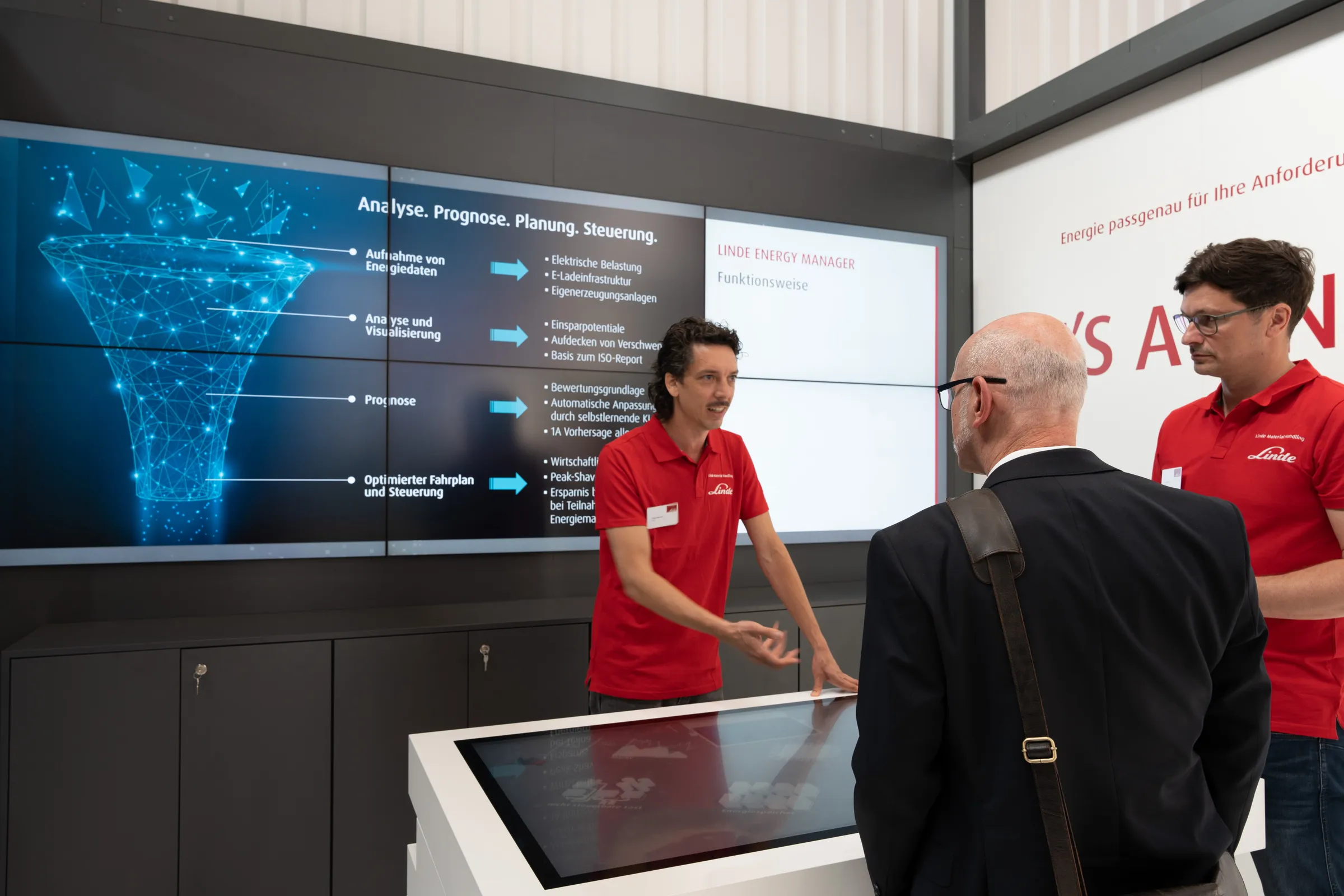
A customer enters the showroom. No trade fair hustle and bustle, no stand staff juggling three conversations at once, no time pressure between appointments in different halls. Instead: a well-prepared welcome, a clear reason for the meeting, and an interactive presentation tailored precisely to their specific needs.
At the multi-touch table, the sales team doesn’t simply open a standard presentation, but rather the relevant use case. An application demonstrates how a complex technology behaves in real-world operations. On the large media wall, data, products and project case studies come together to form a picture that the customer understands immediately. An abstract value proposition is transformed into a concrete context that is relevant to them.
It’s easy to make an impression. What matters is what sticks. It is precisely this success that showroom KPIs make measurable.
A showroom is not just a beautiful space, but a measurable touchpoint
Corporate showrooms, experience centres and innovation centres are often described in terms of their visible features: LED walls, exhibits, architecture, lighting, etc. This is understandable, but it is too narrow a view.
A showroom is a strategic space where companies can explain, persuade and engage in a way that is virtually unrivalled elsewhere. It brings people into contact with products, brand messages and future-oriented topics. Particularly in a B2B context, it can achieve what traditional presentations often fail to do: simplify complexity.
A mechanical engineering firm can demonstrate in its showroom how various systems, services and digital platforms work together. An energy company can explain how infrastructure, networks, sustainability and security of supply are interlinked. A pharmaceutical or chemical company can bring to life processes that are rarely visible in everyday life. A technology group can not only claim to be innovative, but also bring its innovations to life with a demonstrator.
With every showroom project, management asks about the cost-benefit ratio: what does this space actually offer us? Anyone who answers this question solely in terms of visitor numbers or soft factors such as image is squandering potential.
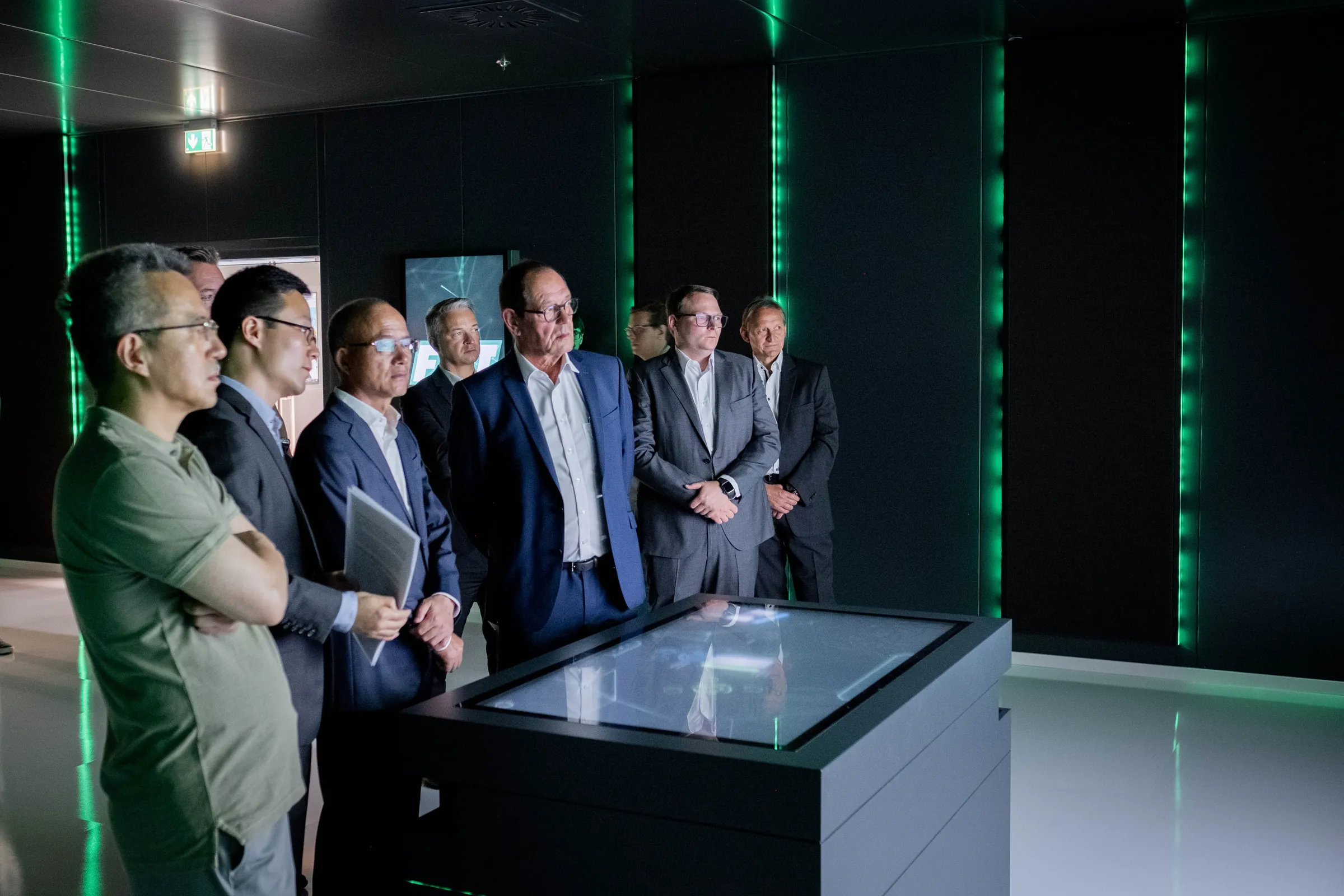
The question of how to measure success should be approached from a strategic perspective
Many discussions about KPIs get off on the wrong foot. People look for figures before the objective is really clear. Yet the first question should be: What role is the showroom supposed to fulfil for the company?
Should he improve sales meetings? Should he explain complex products in an accessible way? Should he impress international client groups? Should he train internal teams? Should he demonstrate innovative thinking? Should he win over job applicants? Should he engage existing customers?
The ‘right’ key performance indicators vary depending on the objective. A showroom used for strategic key account meetings must be assessed differently from a visitor centre with high footfall. An innovation centre requires different KPIs to a sales showroom.
That is why effective performance measurement does not begin with KPIs or a dashboard, but with a clear definition of the objective. First the objective. Then the metric. Then the measurement method.
Comparing it to trade fair appearances is helpful – but only as a starting point
Many companies are familiar with measuring success in the context of trade fairs. After a trade fair, for example, the following figures are calculated: How many contacts were made? How many discussions took place? How many leads were qualified? How many opportunities arose? The cost per contact is then calculated.
The same basic principle applies to corporate showrooms: here, too, it’s all about making contacts, having conversations, making an impact and business relevance. The difference lies in the timeframe. A trade fair generates a sharp peak in contacts over the course of just a few days. There are many conversations, a high number of brief encounters and plenty of spontaneous meetings. Afterwards, the follow-up work begins.
A showroom works differently. It is permanently available. It can be used for years on end. It is more predictable, more controlled and can be integrated more deeply into sales and communication processes.
Visitor numbers are a start, but they are by no means enough
A company should, of course, know how often the showroom is used. How many visitors came last quarter? How many guided tours were held? Which departments use the space? How long do visitors stay on average?
Such hard usage KPIs are important because they show whether the showroom is actually being used at all. No matter how technically impressive a space may be, if the sales and marketing teams hardly use it, it remains an expensive project with no long-term benefit.
However, a busy showroom does not automatically mean a successful one. A single appointment with a strategically important client can be more valuable than a hundred visits with no business relevance. That is why the analysis needs to go a step further.
Quality of contacts beats quantity of contacts
At a trade fair, it is often quantity that counts at first: lots of visitors, lots of conversations, lots of scanned badges. In a showroom, however, the focus should be on quality.
A showroom is not a touchpoint for the masses. It is a place for curated, high-quality and planned interaction. That is why the following aspects of visitor engagement are often more meaningful than visitor numbers alone:
- strategic client visits
- C-level or executive meetings
- Visits to existing customers
- Visits to new customers
- targeted visitor groups
- Follow-up discussions after the visit
- Number of new opportunities
- Pipeline value of opportunities
An example:
An industrial company welcomes 40 groups of visitors to its showroom each year. At first glance, that sounds less impressive than 900 trade fair contacts. However, when 25 of those are strategic accounts, ten concrete project discussions result from them, and three major opportunities are influenced, the assessment takes on a different perspective.
Commitment shows what really matters
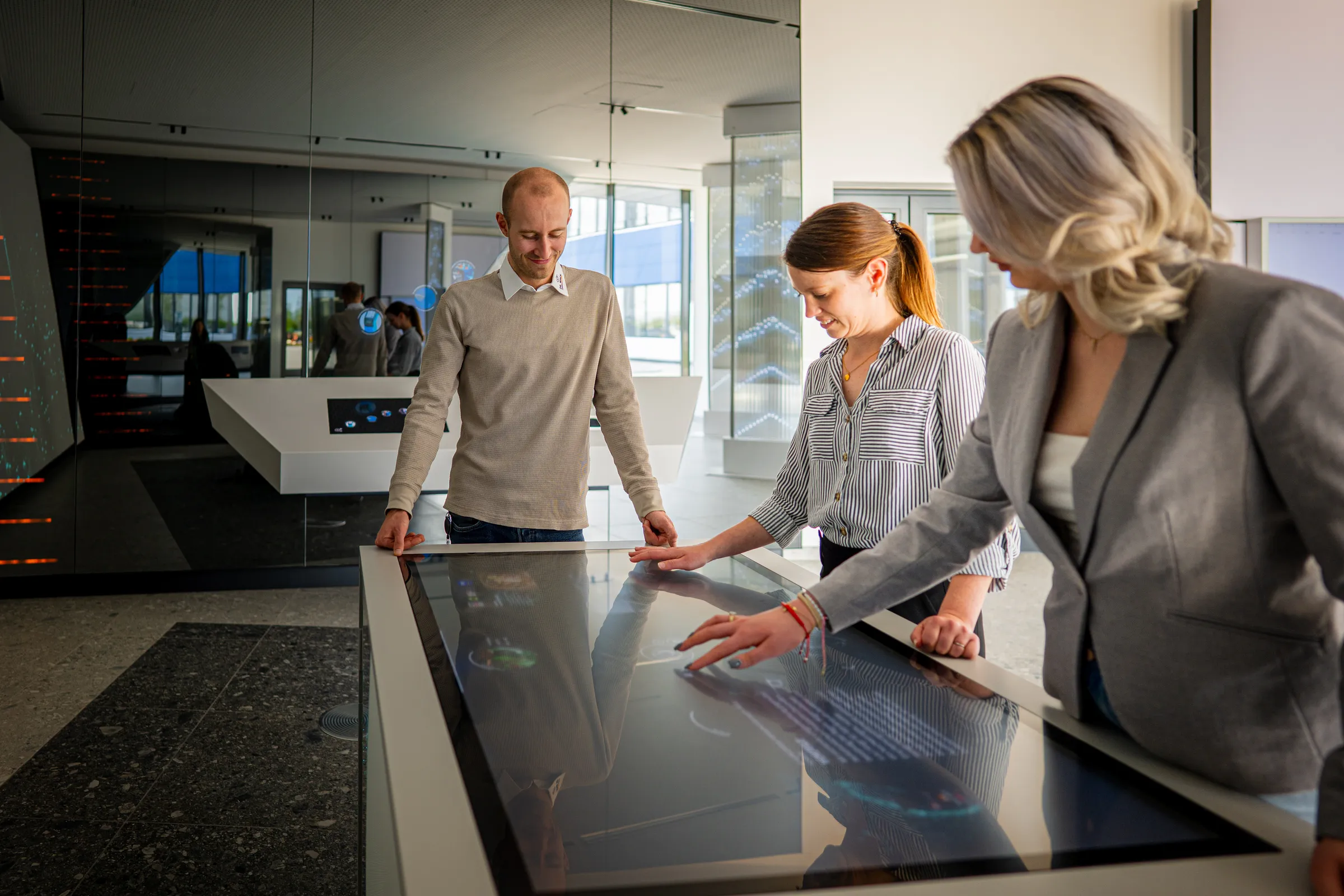
A modern corporate showroom rarely consists of a single presentation. There are usually various stations: multi-touch tables, physical exhibits, 3D visualisations, configurators, simulations, etc. This gives rise to a particularly valuable KPI: engagement with digital exhibits.
Which sections attract visitors? Which content is accessed? Which topics are skipped? Where do visitors spend more time? Where does interaction break off?
This data is valuable because it makes it possible to measure interaction.
Possible engagement KPIs include:
- Number of interactions per station
- Average session duration
- Most popular content / least popular content
- Breakpoints within an application
- Use of certain product ranges
- Use of configurators or comparison tools
If a station is hardly being used, there could be several reasons for this. Perhaps it is poorly situated. Perhaps visitors don’t understand how to get started. Perhaps the content isn’t suited to the visitor group. Showroom KPIs don’t provide ready-made answers. But they do show where you should take a closer look.
Not every sign of interest is reflected in clicks, time spent on the page or interaction paths. Often, the most important insights emerge during conversation. What questions does the group ask? Where do visitors probe further? Which examples elicit agreement? That is why quantitative usage data should always be supplemented by qualitative feedback, for example through feedback to the presenter, short surveys after the visit, digital questionnaires or structured notes from the sales team. This quickly reveals what goes down particularly well with the target groups and where there is still room for improvement.
Sales KPIs link the showroom with the sales department
A corporate showroom really comes into its own when it becomes an integral part of the B2B sales process. The sales team can use the showroom to support and deepen discussions, explain products, make complex offers more tangible or build trust. Of course, a showroom does not replace the face-to-face sales conversation. It simply enhances it.
To this end, the showroom should also be integrated into the customer relationship management system and the follow-up process. Was the customer welcomed in the showroom before the presentation? Which topics sparked particular interest? Was a quote requested after the visit? Was there a follow-up discussion? Has the sales cycle been shortened? Are customers who visit the showroom more likely to make a purchase?
Possible sales KPIs include:
- Number of sales appointments in the showroom
- Number of opportunities with a showroom touchpoint
- Value of opportunities affected by the pipeline
- Conversion rate for customers who visit the showroom
- Shortening the sales cycle
- Cross-selling and upselling signals
An example:
A company makes an interesting contact at a trade fair. Rather than simply sending a brochure, the sales team invites the person to the showroom. There, the initial contact develops into a more in-depth conversation. The conversation leads to a sales opportunity. The sales opportunity leads to a quotation.
The journey is as follows: Trade fair contact. Follow-up. Showroom visit. Opportunity. Quotation. Closing the deal.
In this example, the showroom extends the impact of the trade fair. It turns fleeting encounters into opportunities for personal conversation.
ROI: Costs must be considered over the useful life
A showroom is undoubtedly an investment. It costs time, space and money. That is why the question of ROI is more than justified for the company. However, it should not be approached in the same way as a one-off campaign. A showroom is not a three-day initiative. It is an infrastructure or an asset that can be utilised for years to come.
When it comes to trade fairs, the calculation is straightforward: the total cost of the fair divided by the number of qualified leads gives the cost per qualified lead.
A similar approach can be taken with the showroom: the total cost of the showroom over its useful life, divided by the number of qualified visits, opportunities or sales appointments, gives the cost per qualified showroom contact.
The difference is crucial: a trade fair ends after just a few days. A showroom spreads its investment across many uses over several years. A space that is regularly used for client meetings, press events, recruitment, internal communication and trade fair follow-ups can spread its costs very differently from a temporary trade fair stand. The cost per use should therefore be viewed over the space’s useful life. In corporate showrooms, this is often between five and ten years.
The showroom must learn from its data
KPIs are only valuable if they lead to decisions. If a section is not being used, it needs to be reviewed. If a topic is accessed particularly frequently, it should be utilised more effectively in sales. If many visitors are asking about the same point, an explanation may be missing. If customers convert significantly better after visiting the showroom, this process should be systematically expanded.
Showroom KPIs lead to specific improvements:
- Content is being reprioritised
- Weak stations will be overhauled
- Frequently used topics will be expanded
- Guided tours are becoming better structured
- Sales follow-ups are becoming more personalised
- Visits are prepared in a more targeted manner
- Content is updated regularly in the CMS
A showroom is not a one-off construction project, but an ongoing communication system. And like any good system, it should be maintained, evaluated and further developed.
Data protection: Measuring without monitoring
Anyone collecting showroom KPIs in Germany should take data protection into account right from the start. Camera-based systems are generally ruled out here for various reasons. In the DACH region in particular, analytics must not come across as surveillance. The aim is not to monitor individuals unnecessarily. In many cases, anonymised or aggregated data is entirely sufficient.
A good KPI framework therefore asks this question at an early stage:
- What data do we actually need?
- What do we use them for?
- Who is allowed to see them?
- How long do we keep them for?
An overview of the 5 most important showroom KPIs
In practice, a simple structure helps to ensure that the showroom is not assessed solely on the basis of an abstract figure. It presents usage, relevance, impact and economic contribution together. The key performance indicators can be divided into five groups.
Usage:
Visitors per month, number of guided tours, number of client appointments, duration of visits, capacity utilisation, internal use
Contact quality:
Strategic accounts, meetings with decision-makers, visits to existing clients, visits to prospective clients, follow-up meetings, qualified visitor groups
Commitment:
Interactions per station, session duration, most frequently used content, drop-off points, use of configurators, topic paths
Understanding and experience:
Recall of key messages, perceived innovative strength, clarity of complex content, qualitative feedback
Business impact:
Opportunities with showroom touchpoints, pipeline value, quotes following visits, close rate, sales cycle reduction, cost per qualified lead
Conclusion: The best showroom is the one that makes the biggest impact
A corporate showroom doesn’t just have to look good. It has to make an impact. It should enhance conversations, make products easier to understand, bring brand positioning to life, engage customers, support sales and help prepare B2B decisions.
Experience from the trade fair context shows that face-to-face interactions can be measured in both quantitative and qualitative terms. The showroom takes this a step further: it makes these interactions repeatable, controllable and optimisable in the long term. This is precisely where its strategic value for businesses lies.
Garamantis develops interactive corporate showrooms that combine space, software, content and technology to create a measurable experience — from strategic conception and bespoke applications through to the integration of CMS, sensor technology, CRM connectivity and analytics.