
Intelligent Space: Interactive spaces that respond to people
- Showroom
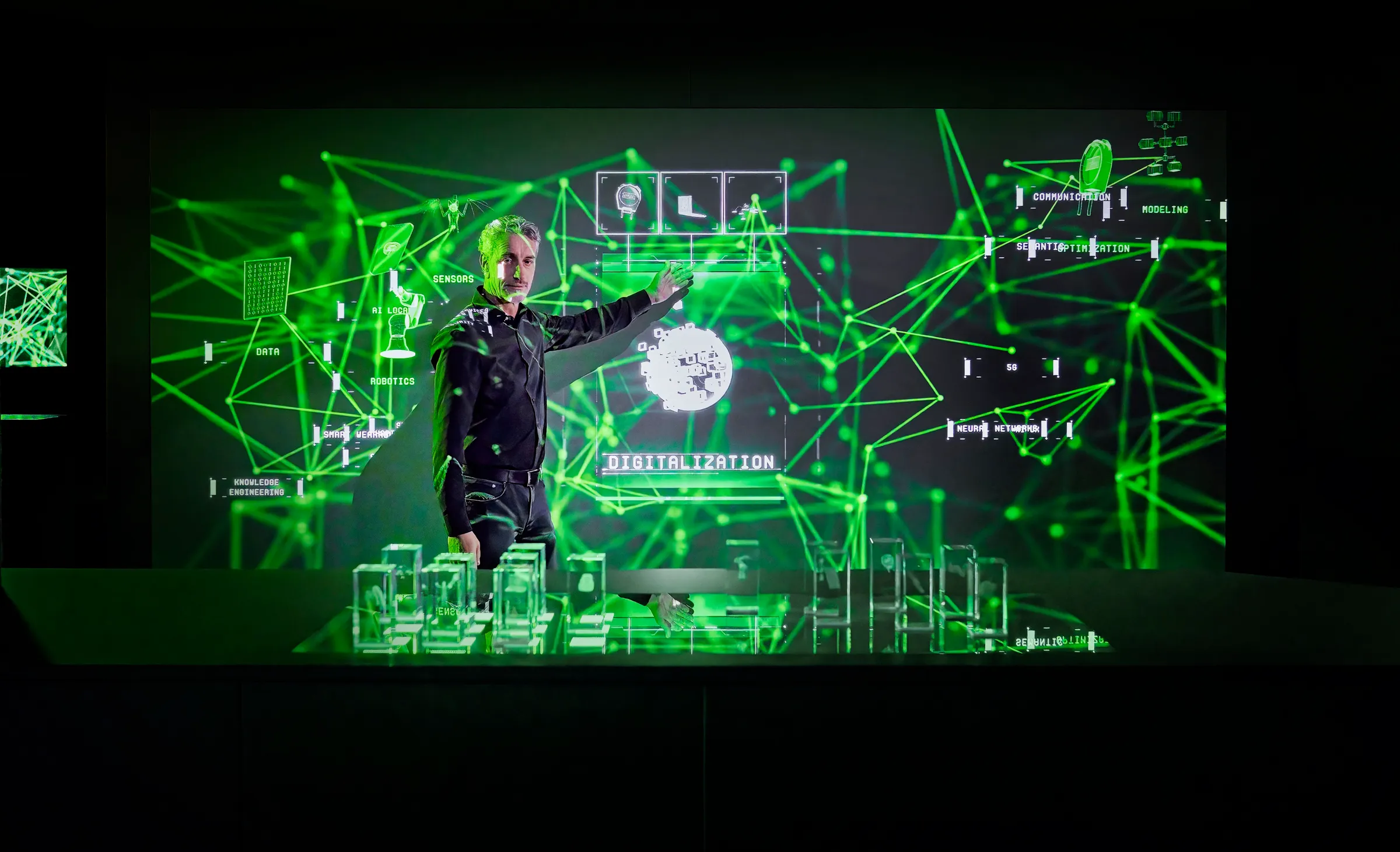
An ‘Intelligent Space’ is a physical space with a digital layer. This layer perceives context, coordinates content and technology, and responds appropriately to people. In a showroom, an exhibition or a brand experience, this intelligence is not measured by the number of sensors or screens. What matters is how naturally the space helps people to explore, understand and remember relevant content.
Garamantis develops smart spaces as holistic experiences. Content, software, media, hardware and spatial design all work together as a single system. When you touch the table, a product model opens on the media wall. A visitor’s position alters the lighting and sound. The space adapts automatically. A presenter uses a single interface to tailor the entire journey to the group in question. The technology takes a back seat to the experience – and that is precisely the crux of the matter.
How does an Intelligent Space work?
An Intelligent Space detects what is happening in the room, interprets the situation and triggers an appropriate response. Possible inputs include, for example, movement, position, touch, objects, speech or live data. The output may consist of visual content, sounds, lighting, physical movements or a coordinated change across several stations within the space.
The scientific origins of the term lie in sensors, connected devices and actuators. Current research into AI-driven smart spaces complements communication, analytics and personalised indoor experiences. For brand and knowledge spaces, however, a purely technical response is not enough. It must support the communication objective and remain comprehensible to visitors.
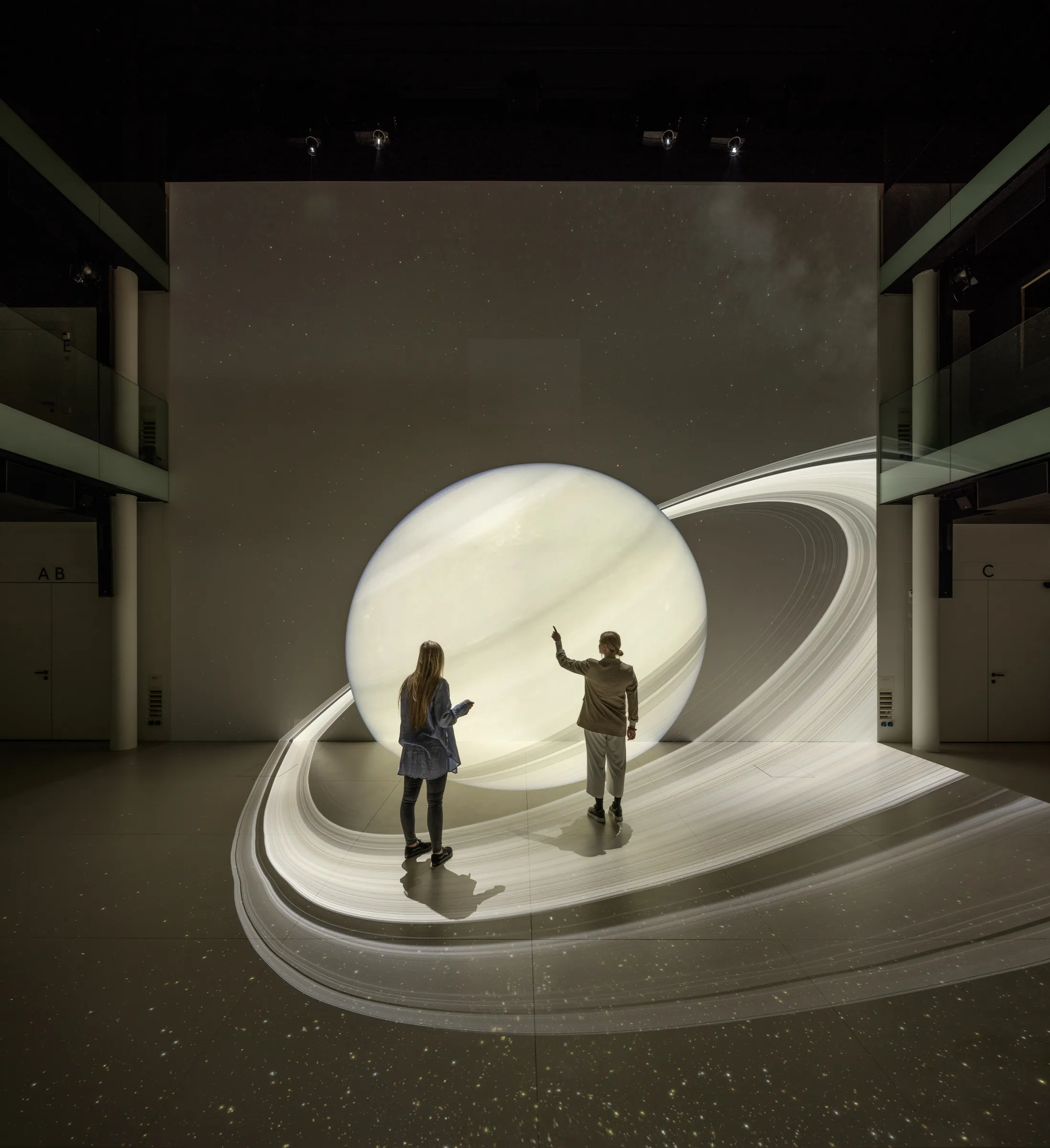
Intelligent space, smart space, interactive space or immersive space?
The terms overlap, but they are not interchangeable. A useful way of distinguishing between them starts with the main purpose of the space in question.
Term
Key question
Typical elements
Key benefits
Smart space / smarter space
How can the environment operate more efficiently?
Occupancy sensors, access control, lighting, IoT, building management
Comfort, efficiency, safety and operational data
Interactive space / interaktiver Raum
How do people influence events?
Touch, gestures, movement, objects, speech, controllers
Involvement, exploration and immediate feedback
Immersive space
How do people feel when they are immersed in an experience?
Projection, LED, spatial audio, lighting, scenography
Emotion, presence and sensory impact
Intelligent Space / intelligent space
How does the entire space understand context and respond in a coherent manner?
Experience logic, software, sensor technology, media, control systems, CMS and space
A relevant, personalised and connected end-to-end experience
A smart building can be highly automated without offering an engaging visitor experience. The primary focus here is on designing the lighting, temperature and indoor climate to be as pleasant and energy-efficient as possible. An Intelligent Space, on the other hand, combines multi-sensory impressions to create a holistic experience – and does so with a specific purpose in mind from the company’s perspective.
This might involve, for example, explaining a complex product, guiding a group through the company’s history, bringing research to life, or creating an unforgettable brand experience. The best solution may well combine smart, interactive and immersive elements. This requires a range of technologies that are precisely tailored to this purpose.
What makes an Intelligent Space truly intelligent
A successful Intelligent Space is made up of six interlinked components. These are defined during the design phase at the start of a project.
1. Objective and Experience Strategy
We start with people, content and communication objectives. Who enters the space? What should visitors understand, feel or decide? Is the space intended for free exploration, guided tours, or both? How long do visitors stay in the space?
2. Sensors and input
The space needs a straightforward way of capturing actions or context. Depending on the application, this could be a multi-touch surface, laser tracking, a camera, RFID, a physical button, object recognition, a mobile device or a data interface.
3. Experience logic
The experience logic is the choreography behind the space. It determines what happens following an input, how the individual stations interact with one another, which content becomes relevant, and how the system responds to different situations. It also prevents a common pitfall: multiple impressive installations all vying for attention at the same time.
4. Real-time software
The software links the visitor’s journey with data, content and technical control. It organises user flows, visualisations, interactions, synchronisations and system states. A quick response is crucial. As soon as there is a noticeable delay between an action and a response, the interaction no longer feels natural.
5. Media, hardware and interior design
Displays, projections, lighting, sound, exhibits and sensors must form an integral part of the space. That is why we regard interface design, media dramaturgy and spatial design as a shared endeavour. Our aim is not to incorporate more technology; rather, it is to create a harmonious environment.
6. Content management and operations
Even after the opening day, an Intelligent Space must remain up to date at all times. A suitable content management system enables themes, content and customer-specific presentations to be updated. Monitoring, maintenance and streamlined processes ensure reliable day-to-day operation.
Where smart rooms create business value
Corporate Showrooms and Executive Briefing Centres
Complex B2B products rarely lend themselves to a linear presentation. In an interactive showroom, visitors can explore features, compare variants, view technical details and identify connections across different media. Sales teams guide visitors through the journey whilst still retaining the flexibility to respond to questions and address specific interests.
Museums, exhibitions and visitor centres
An Interactive Space can transform archives, scientific data and abstract processes into something that visitors can explore for themselves. It offers curious visitors a quick introduction and provides specialists with deeper insights, without forcing everyone to follow the same linear sequence.
Lobbies and Innovation Spaces
An interactive foyer can be more than just a waiting area. Responsive content can welcome groups, showcase current projects, link physical exhibits with digital information, or set the mood for an event. In this way, the space becomes a vibrant introduction to the company.
Interactive product presentations
Interactive displays, transparent screens, object recognition and gesture control combine physical products with digital depth. Visitors can compare configurations, discover features or explore a product that is too large, too complex or not available on site.
From individual technical components to a cohesive experience
The most common planning mistake is to start selecting AV media and hardware – such as a large LED wall, a transparent display or a sensor – too early. This turns the logic on its head. The technology should only be selected once the target audience, the message and the desired interaction have been defined.
Human-centred designprovides a sound foundation. ISO 9241-210 describes a process that understands users, tasks and the context of use, involves people in the development process, evaluates designs and improves them iteratively. We apply this principle to the entire space: the interface, content, hardware, lighting, sound and visitor guidance are developed as a single system.
This approach ensures that the interface is easy to understand. Visitors should be able to recognise within a few seconds which actions are possible and what the consequences of those actions are. The complexity can remain within the software architecture. However, the interface must feel simple and intuitive.
Three real-world examples of Intelligent Space
A showroom that responds to visitor movements
In the Procurement Future Showroom, a multi-touch table is connected to a six-part media wall and the client’s IoT solutions. The room control system dynamically adjusts the sound and lighting to visitors’ positions. As a result, the content, atmosphere and interaction function as a single system rather than as individual effects.
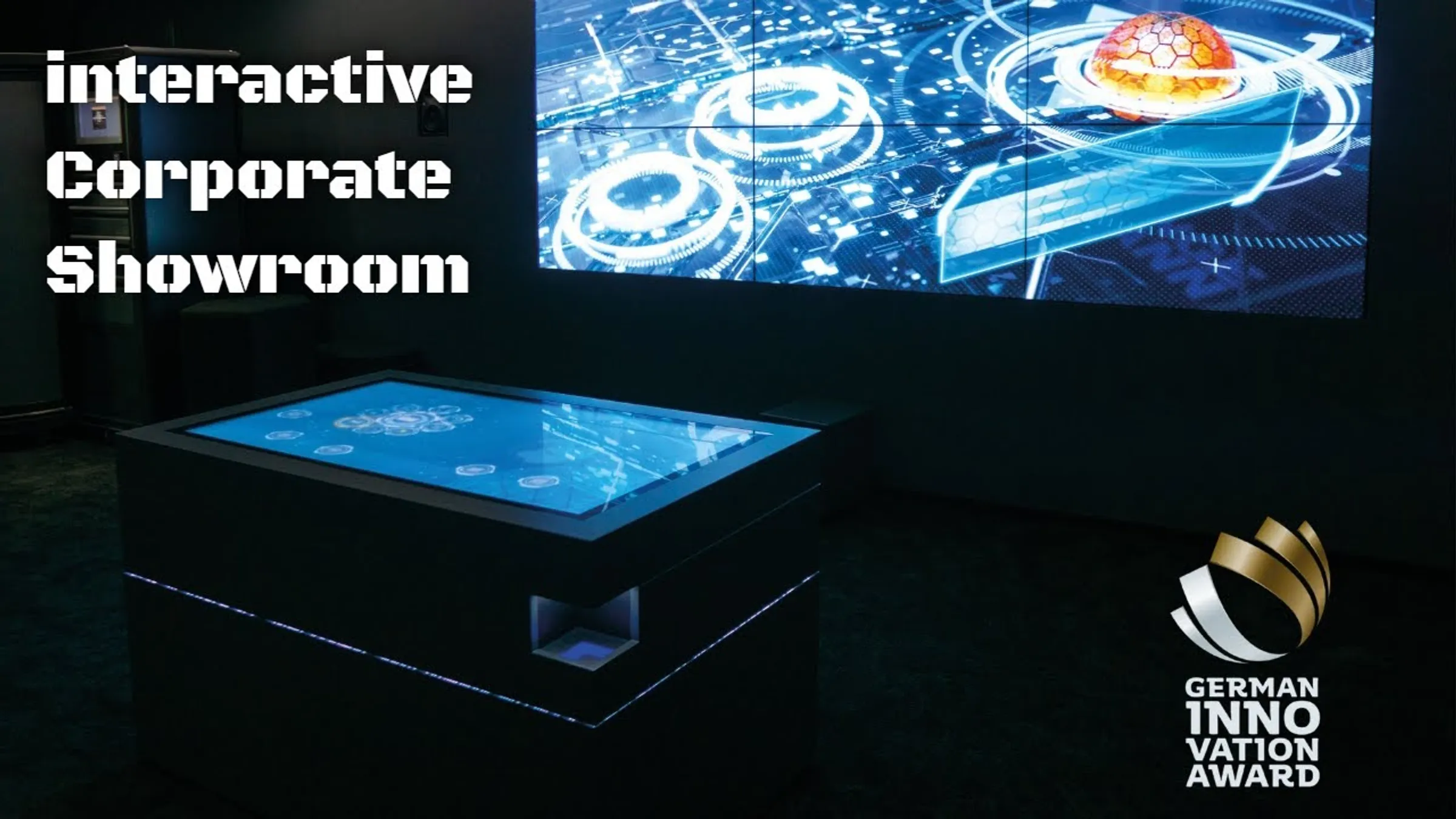
Dieser Inhalt wird von einem Drittanbieter gehostet. Durch das Anzeigen des externen Inhalts akzeptieren Sie die Nutzungsbedingungen von youtube.com.
An interactive production environment
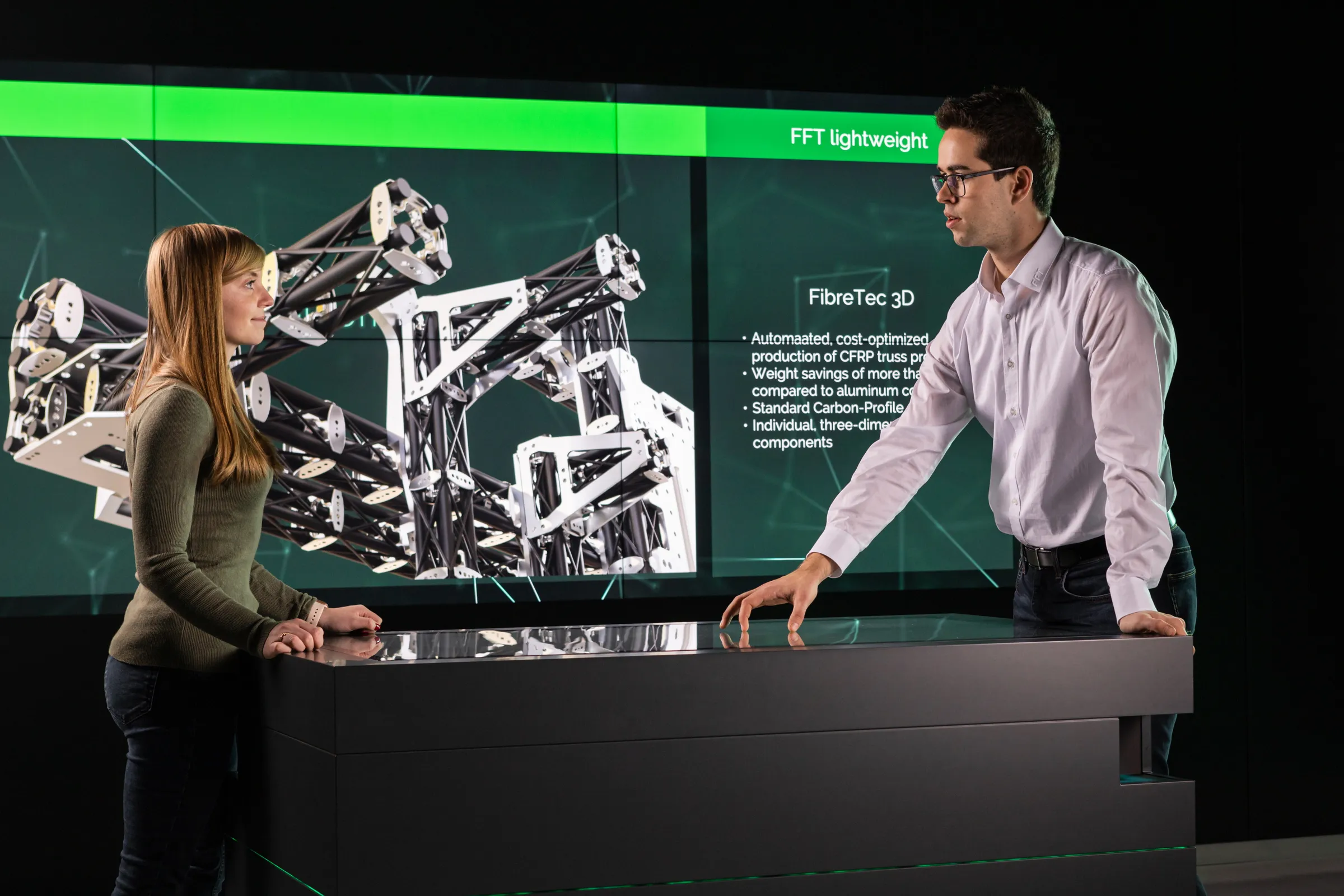
The FFT Production Systems Showroom combines digital presentation with a live production environment. Visitors explore complex manufacturing systems, engage with interactive content and incorporate physical automation directly into the explanation. The space supports sales, communication and practical understanding all at once.
Smart space responds spontaneously to visitors’ wishes
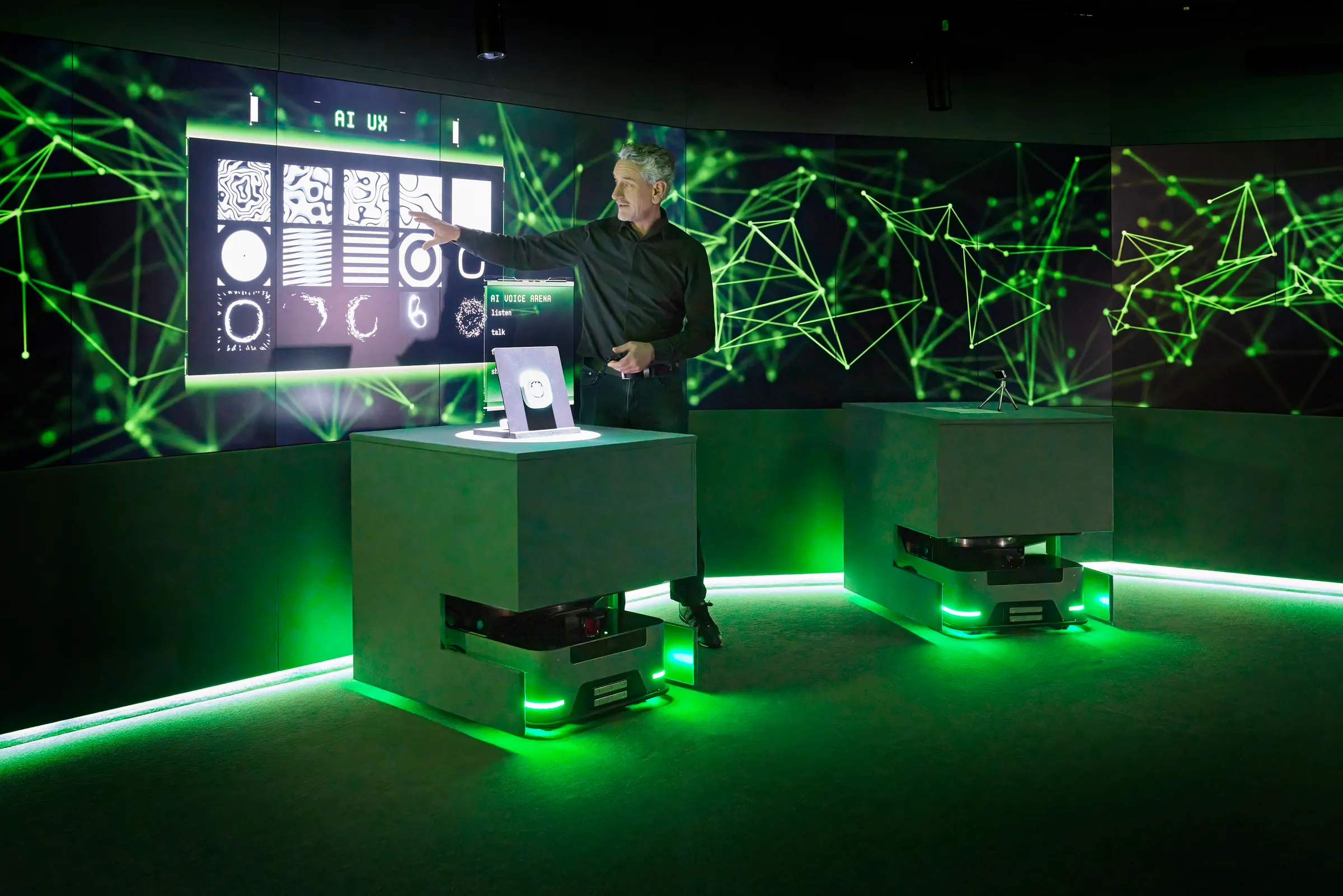
The “KEBA Innovation Space” marks the opening of a digital showroom that is unique worldwide. The interactive concept is designed to deliver a fully personalised customer experience. Visitors first select the topics and technologies that are relevant to them. The showroom is then configured according to this selection, with Automated Guided Vehicles (AGVs) entering the presentation area to display exhibits in conjunction with digital content.
This is how Garamantis develops an Intelligent Space in five steps
Our project process combines strategy, design and implementation – from the first workshop right through to ongoing operations.
Step 1: Concept & Experience Strategy
We analyse target audiences, content, usage scenarios and communication objectives. This results in a clear concept, the visitor journey and a solid foundation for the scope, timing and budget.
Step 2: Interactive Space Design
We translate messages and products into spatial design, media dramaturgy and interfaces. It is during this phase that we see how people move, find their way, understand and interact.
Step 3: Experience Logic & Software
We develop the digital architecture: user flows, interaction principles, real-time software, content management and technical control. We integrate sensors and data sources where they actually add value.
Step 4: Hardware & System Integration
Displays, projection, sensor technology, lighting, audio, exhibits and bespoke technical solutions come together to form a fully functional installation. Responsibilities remain clearly defined because the technical and experiential aspects are planned in tandem.
Step 5: Implementation & Operation
We commission the system, test and optimise it, train staff and provide support following the launch. Content remains customisable, and the space is prepared for reliable, continuous operation. You can find out more about the process in our project workflow.
What you should decide before choosing a technology
Decision-making area
Key question
Purpose
What should visitors understand, feel or do as a result of the experience?
Target groups
Which groups use the space, and how do their knowledge and needs differ?
Usage mode
What format does the tour take – is it self-guided, led by a guide, or a combination of both?
Depth of content
Which information requires a quick overview, and which requires in-depth analysis?
Interaction
Which actions feel natural within the spatial context? How do the characters move through the story?
Integration
Which data sources, products, building systems or existing media need to be integrated?
Operation
Who updates the content, starts up the system, deals with faults and measures usage?
Life cycle
How does the space remain relevant when products, content or languages change?
A workshop and an early prototype generally provide more insights than a long list of hardware. They highlight assumptions and enable future users to test the interaction before the space is built and expensive hardware is procured.
Does an Intelligent Space require artificial intelligence?
No, because many smart rooms work best with deterministic real-time logic: if a visitor touches an object, the system recognises the input and triggers the planned response. This is fast, predictable and easy to test.
AI, on the other hand, is useful when a system needs to interpret complex patterns, natural language, visual inputs or changing contexts. AI can support personalised recommendations, content search, anomaly detection or adaptive control. However, AI should be used to solve a specific problem. Simply adding the ‘AI’ label makes the Intelligent Space more difficult to explain, test and operate. At the same time, AI also carries a certain degree of risk, as results and actions are not always predictable. A well-planned data foundation and very detailed testing are therefore prerequisites for such a use case.
Data protection, accessibility and reliable operation
Integrating data protection into sensor technology
Sensors should not allow for personal identification. As a rule, position, movement or interaction with objects can be processed without collecting or storing identifiable data. For this reason, LIDAR sensors are preferable to camera-based systems, for example.
However, whenever personal data is involved, the approach should adhere to the principles of data protection by design and privacy-friendly defaults, define a legitimate purpose and minimise data collection.
Making interaction accessible
A single mode of interaction with no alternatives can exclude people. Where possible, therefore, offer alternatives to touch. Avoid gestures that require a high degree of precision, and use clear contrasts and font sizes that are easy to read. Include captions and take into account arm lengths, viewing distance and mobility. The W3C’s accessibility guidelinesprovide a good foundation for this – including for kiosk systems and dynamic applications.
Planning for a typical day at the exhibition
The opening day is not the toughest test. What really counts is an average day months later. The space must operate consistently, be able to cope with interruptions and disruptions, and be accessible to large numbers of people. That is why monitoring, documentation, training and support are an integral part of every project.
When is an Intelligent Space a worthwhile investment?
An Intelligent Space is particularly valuable for businesses where content is complex, where different target audiences require varying levels of detail, or where a physical space needs to do more than simply display information. It is also suitable where a showroom, visitor centre or exhibition needs to remain flexible over many years.
You do not need a fully developed technical concept to get the project off the ground. Simply bring us the communication challenge, the target audience and your requirements. We will translate this initial situation into a spatial experience, a technical system and a robust operational solution.
Discover more project examples or get in touchto find out what an Intelligent Space can do for your area.
FAQ on Intelligent Space and smart spaces
What is an Intelligent Space?
An ‘Intelligent Space’ is a physical space in which software, sensors, content, media, hardware and spatial elements are coordinated. This enables the environment to perceive context and respond appropriately to people.
What is the difference between Intelligent Space, Smart Spaces, Interactive Space and Immersive Space?
Smart Spaces generally focus on connected building management and efficiency. An Interactive Space, on the other hand, responds directly to user input. An immersive space envelops people in a sensory experience. An Intelligent Space combines context, interaction and multiple systems around a defined purpose.
Does an ‘Intelligent Space’ always require artificial intelligence?
No, because many smart rooms use reliable real-time rules and experience-based logic rather than AI. Artificial intelligence, on the other hand, is useful when complex interpretation, natural language processing, pattern recognition or adaptive decision-making offer a clear advantage.
What technologies are used in an Intelligent Space?
Typical technologies include multi-touch interfaces, cameras, laser tracking, RFID, object recognition, displays, projection, LEDs, spatial audio, lighting control, real-time software, data interfaces and content management systems.
Where are smart rooms used?
Smart spaces are ideal for corporate showrooms, executive briefing centres, museums, exhibitions, visitor centres, innovation spaces and foyers – particularly when the aim is to present complex content in a way that is easy to understand and memorable.
How do you go about planning an Intelligent Space?
Start by identifying the target audience, communication objectives, content and usage scenarios. Develop the visitor journey, define meaningful interactions and test the experience using a prototype before selecting the final technology.
How can content be updated after launch?
A bespoke content management system enables teams to update topics, languages, media and client-specific presentations without altering the underlying installation.
How are data protection and accessibility taken into account?
Data protection and accessibility should be part of the design from the outset. Minimise the use of personal data, provide transparent information about how it is processed, offer a range of interaction methods, and test user interfaces in their actual physical context.