
Interactive walls – technologies, costs and applications
- Trade fair
- Showroom
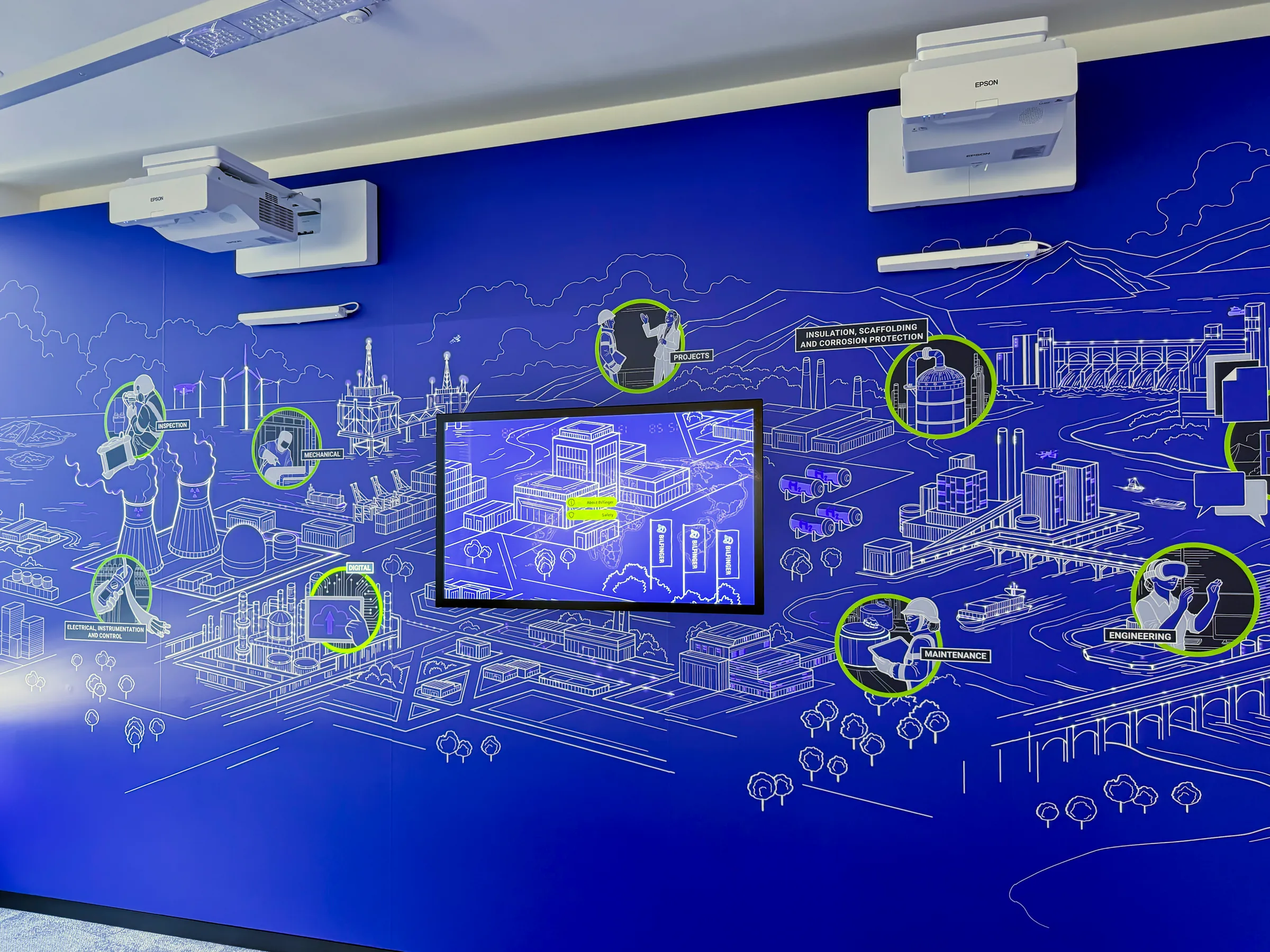
Interactive walls are being used in an increasing number of exhibitions, showrooms and trade fair stands. At their best, they have a strong visual impact from a distance, convey information and captivate visitors through playful interaction. At the same time, they take up little space and are a real eye-catcher. However, companies wishing to capitalise on these benefits are faced with the question of which technology is best suited to their specific purpose. To ensure that nothing goes wrong during implementation, we at Garamantis have compiled some conceptual guidelines and tips based on our experience with interactive wall installations.
4 technologies for interactive walls
An interactive wall can be designed in various ways, ranging from analogue elements featuring products and display cases to full-surface multi-touch video walls. So, let’s start with an overview of the interactive technology and its benefits.
1. LED screens
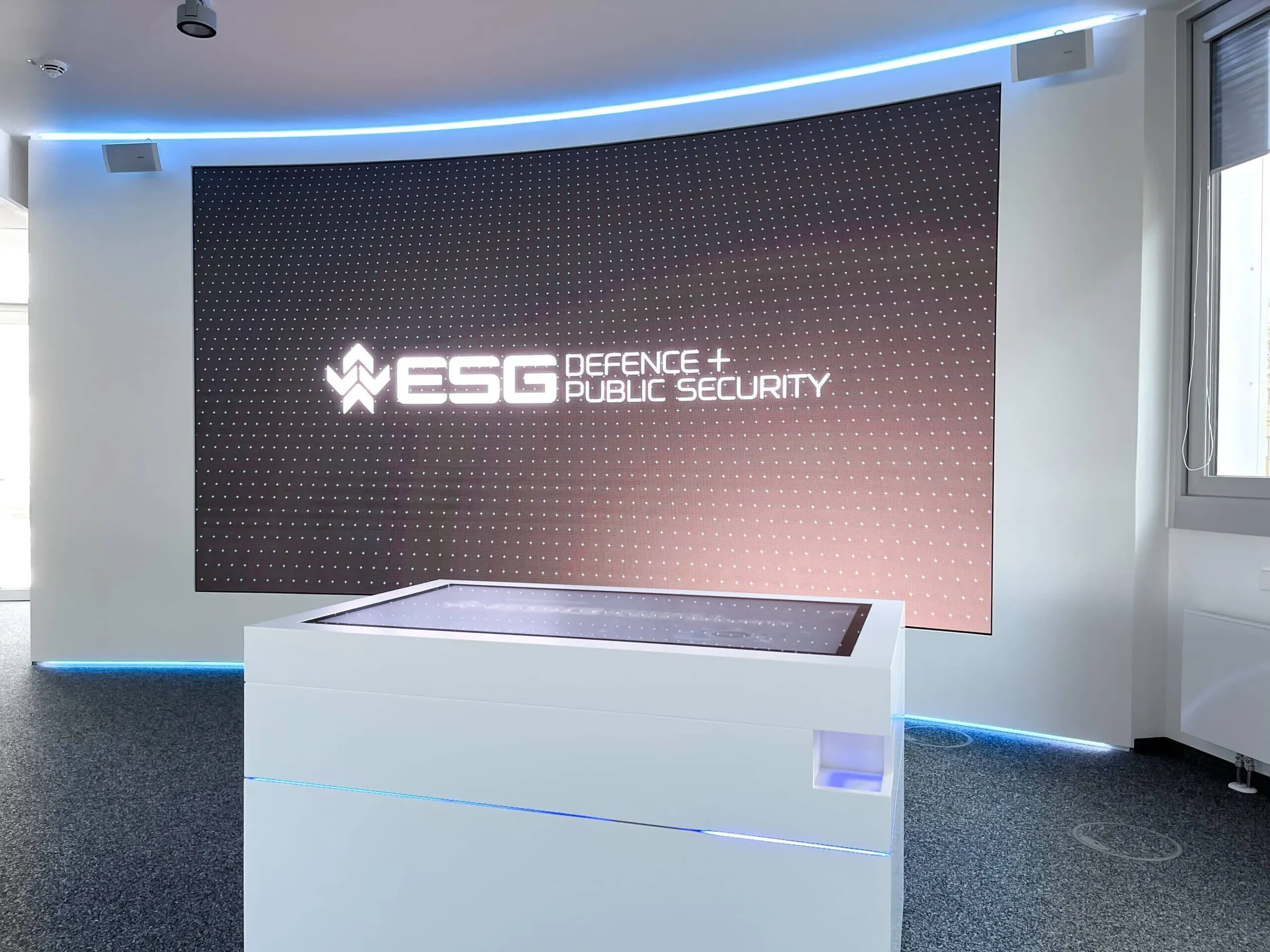
Interactive walls using LED technology offer the highest brightness and therefore the best visibility from a distance. Even in large, well-lit exhibition halls, they shine clearly and are visible from a distance. Potential drawbacks include a potentially low pixel density (pixel pitch), which can be problematic at close viewing distances, as well as the high cost per square metre. The appearance of classic (unlaminated) LED walls is also rather distinctive and does not suit every environment. LED walls are therefore suitable as eye-catchers, but less so for actual interaction. Directly in front of them, it is simply too bright and ‘pixelated’. For interaction, people sensors, depth cameras or Lidar lasers are suitable. Here is an LED configurator from Samsung that you can have a play with.
2. individual multi-touch displays
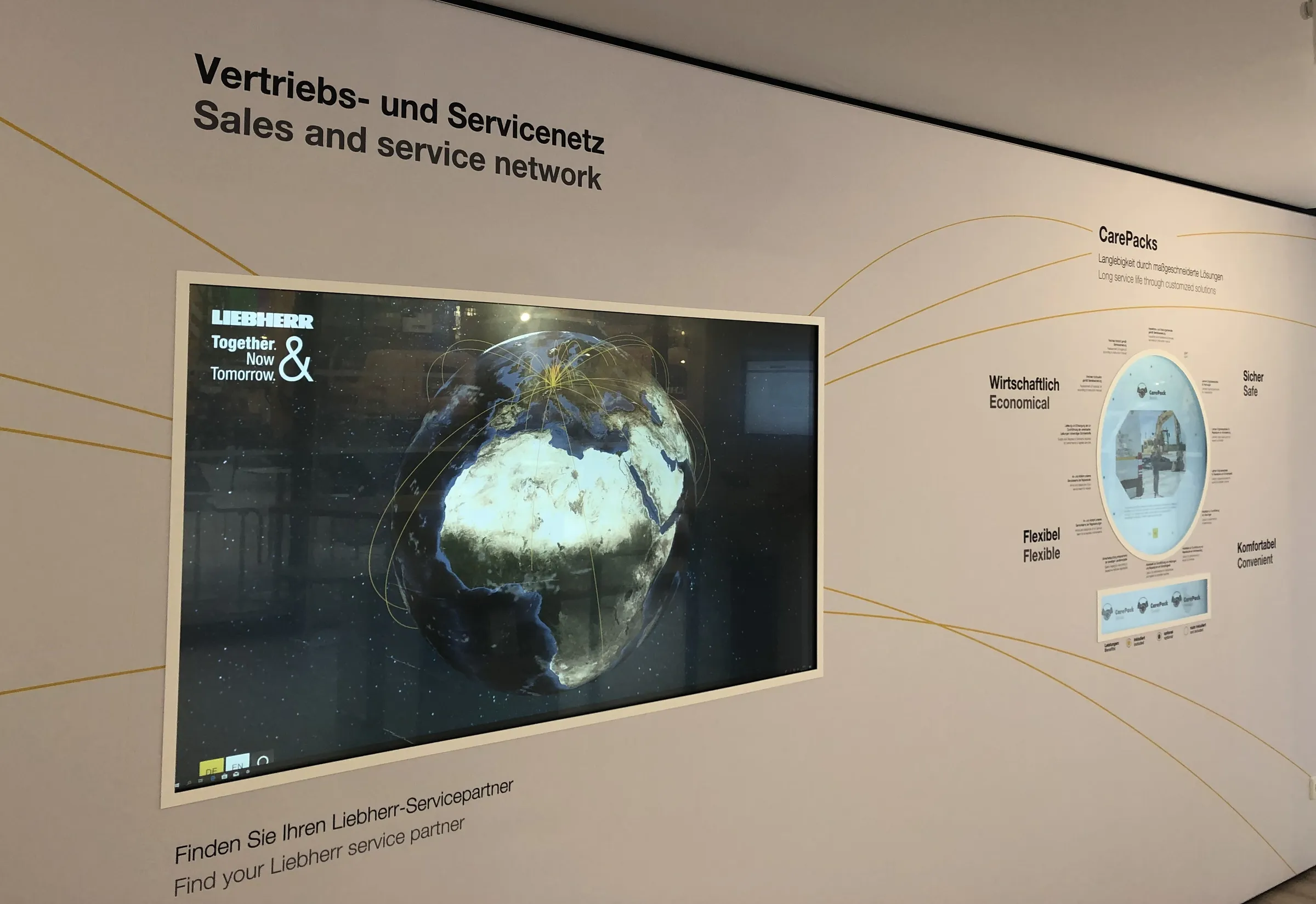
Capacitive multi-touch screens are suitable not only for multi-touch tables but also for wall mounting. They are best suited for (touch) interaction. The capacitive sensor integrated into the display enables precise and robust touch recognition. Users can navigate effortlessly through content and enjoy high resolutions (4K) with good brightness. Disadvantage: Multitouch displays have a bezel several centimetres wide. They can therefore only be installed individually and not flush within a grid. Standard multi-touch displays are currently available in sizes ranging from around 55 to 86 inches. For particularly large applications, models measuring 98, 105 or even 110 inches are now also available. A 105-inch display, for example, has a screen diagonal of around 267 centimetres and, particularly in the wide 21:9 aspect ratio, can already be used as a compact interactive wall. Affordable displays are available, for example, from the Japanese manufacturer iiyama.
3. Multi-touch video walls
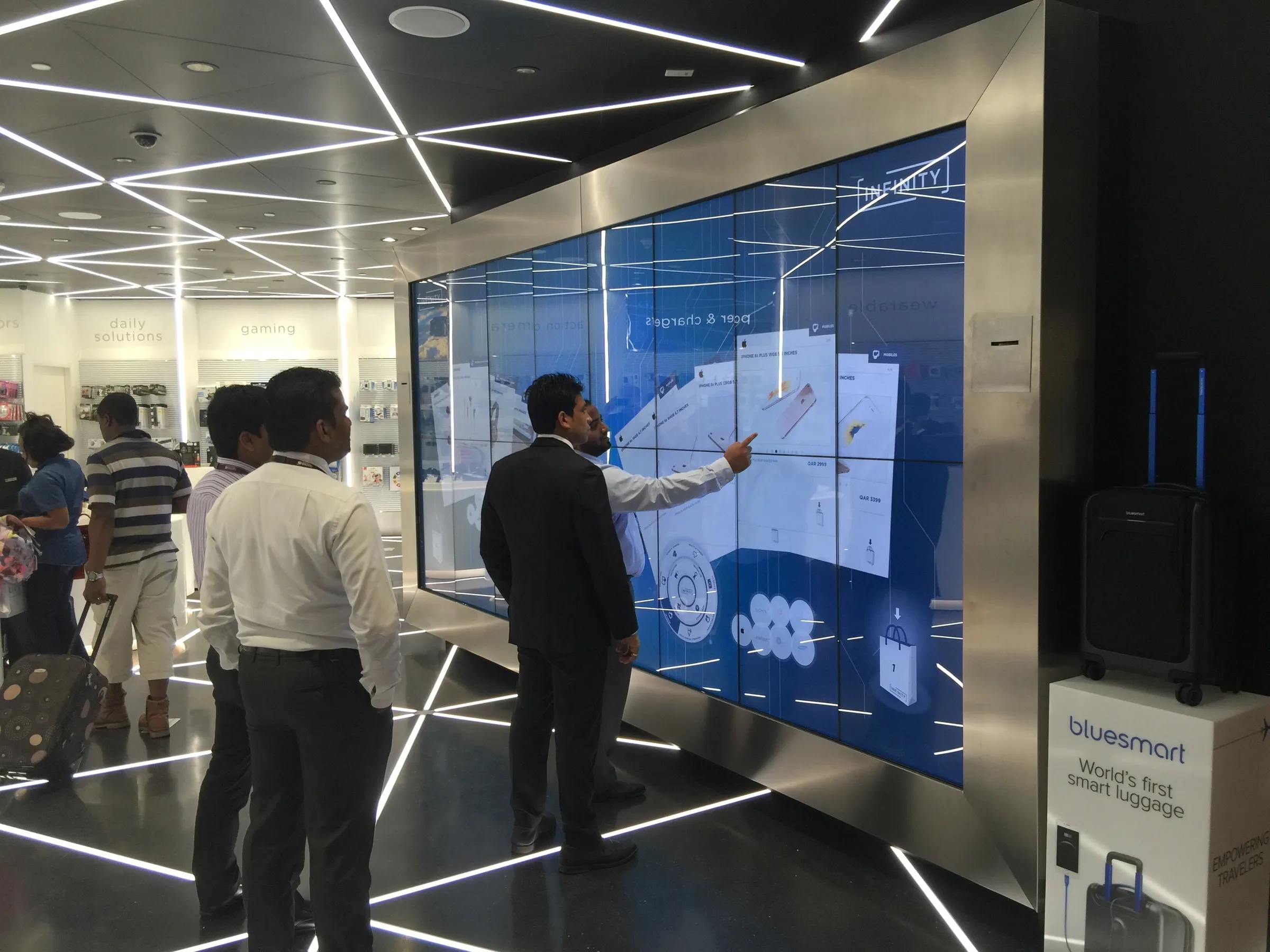
Also known as a touch wall or touch video wall. These consist of a grid of passive displays with minimal bezels (‘bezel-free’). By arranging screens of different sizes and orientations side by side, wall surfaces of varying dimensions and aspect ratios can be created. The interactive sensor is “retrofitted” here, for example in the form of an infrared (IR) frame or a laser curtain (LIDAR) positioned just in front of the displays. Users’ fingers break through this invisible light barrier, thereby triggering the touch response. The result is high brightness, good precision and good interactivity. Unfortunately, the hardware is also costly per unit area. Here is a video wall configurator from Sharp/NEC (excluding the touch sensors).
4. Interactive wall projections
Wall projections that respond to users’ touch are another way of making large surfaces interactive. With a careful choice of hardware, large-scale interactive walls can thus be created. A particular element of surprise is created by precisely aligning the projection with analogue or haptic elements on the wall (projection mapping). This becomes challenging in particularly bright environments, where expensive projectors with very high light output (measured in ANSI lumens) are required. Here is a rule of thumb for calculating the required light output: ANSI lumens ÷ projection area in m² = image illuminance in lux.
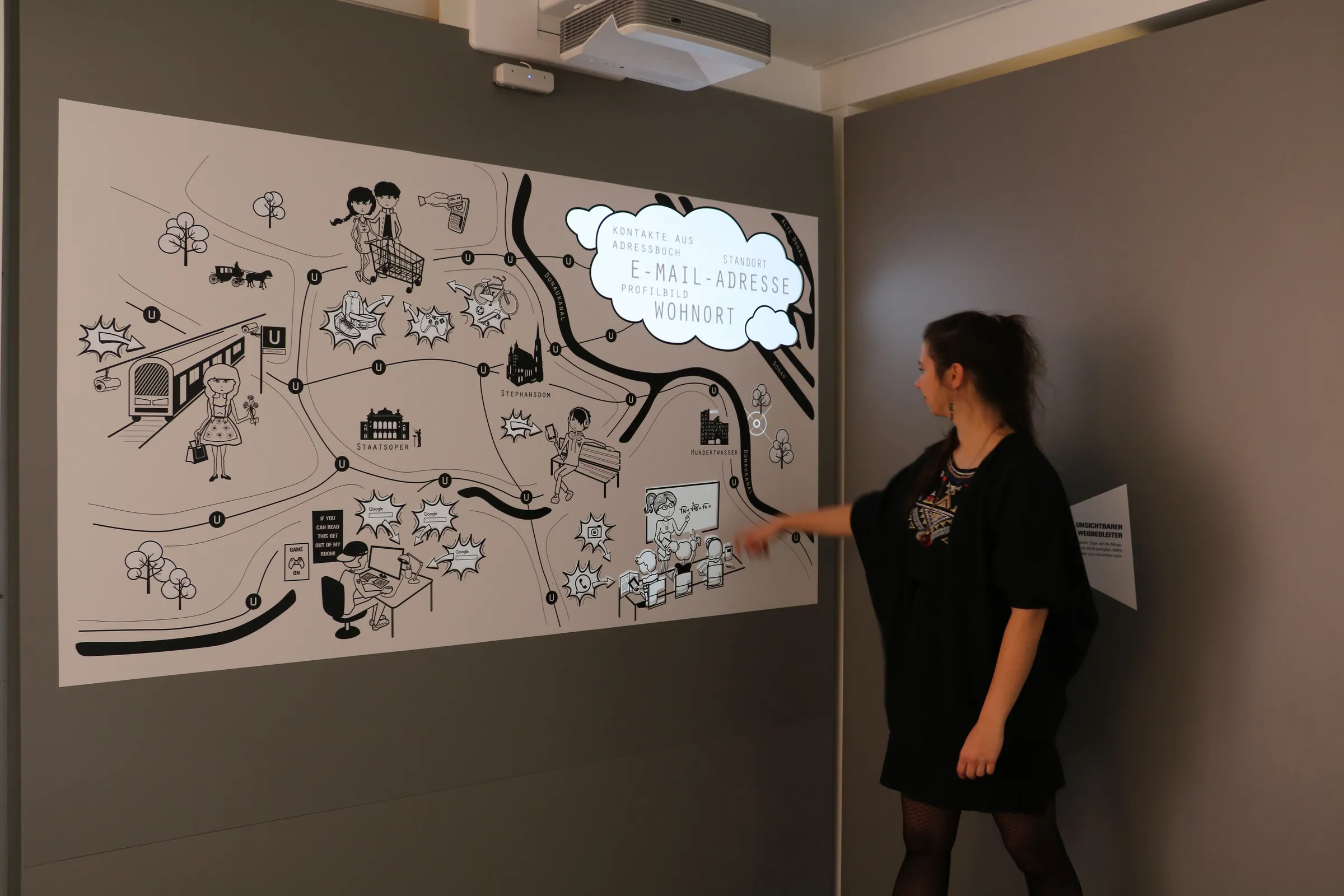
Combining different technologies to create an interactive wall – the ideal solution?
In our experience, the success of interactive wall projects depends entirely on the concept. You should first ask yourself what effect you wish to achieve, for which target audience and in which environment. Examples:
- Attract visitors’ attention and draw them to the exhibition stand
- Presentation area for groups in a showroom
- Visitors exploring the exhibition content at their own pace
- Staff promoting the company’s products and services
The good news is that you don’t usually have to limit yourself to a single technology. Often, a combination makes sense and can even save on the hardware budget.
Example: In a showroom, a wall five metres wide and three metres high is to be made interactive. An LED frame creates an atmospheric backdrop for the wall. Large-scale animations and videos are projected onto the wall, drawing inspiration from the analogue design featuring prints and actual products on display. Individual pieces of content transition seamlessly from the projection onto several recessed multi-touch displays, where they can be explored in greater depth. In this example, no large-scale multi-touch video wall is used, which significantly reduces hardware costs. Combined with a well-thought-out concept, this kind of technology mix on an interactive wall creates a unique experience for your target audiences.
Planning: usage patterns, space requirements, lighting and viewing distance
When planning an interactive wall, the intended use, available space, ambient light and viewing distance must all be taken into account. The key consideration is whether individuals will interact directly via touch, groups will view content, or visitors are to be engaged from a greater distance. Bright rooms require particularly high-brightness displays, LED technology or high-performance projectors. The size, resolution and position of the wall should also be chosen so that content is clearly visible from the intended viewing distance and control elements are within easy reach.
5 tips for planning interactive walls
- Reducing the number of PCs: The number of PCs used for control and content display should be kept to a minimum. Ideally, there should be just one PC controlling the entire wall. This saves on hardware costs and reduces administrative workload.
- Maximum interactivity: The combination of different sensors enhances interactivity. A camera or a motion sensor can detect visitors from several metres away and trigger a response from the wall. At close range, interaction then takes place via touch or gesture control.
- Flexible and customisable: A content management system should make it easy to integrate new themes and content. With minimal effort, you can adapt the display to suit any trade fair and new products.
- Cost-conscious planning: The concept phase not only lays the foundations for success, but also defines the project’s costs. The clearer the objective and the requirements, the better you can select the hardware.
- Truly impressive: What matters more than the hardware is the content displayed on the interactive wall – essentially, the software. With a good concept and bespoke software that’s fun to use, even a small wall can make a huge impact.
How much does an interactive wall cost?
The cost of an interactive wall depends primarily on its size, the technology used and the scope of the bespoke content. The main cost components include the concept and technical planning, illustration, media design and animation, the development of the software and an optional content management system, as well as the construction and design of the wall – for example, using plasterboard, timber or film. Added to this are hardware components such as PCs, touchscreens, projectors, LED modules, network components and LiDAR sensors. On-site installation and commissioning of the technology, as well as project management, must also be taken into account. Consequently, the price can only be reliably estimated once the spatial, technical and content-related requirements have been clarified.
An interactive wall for your business?
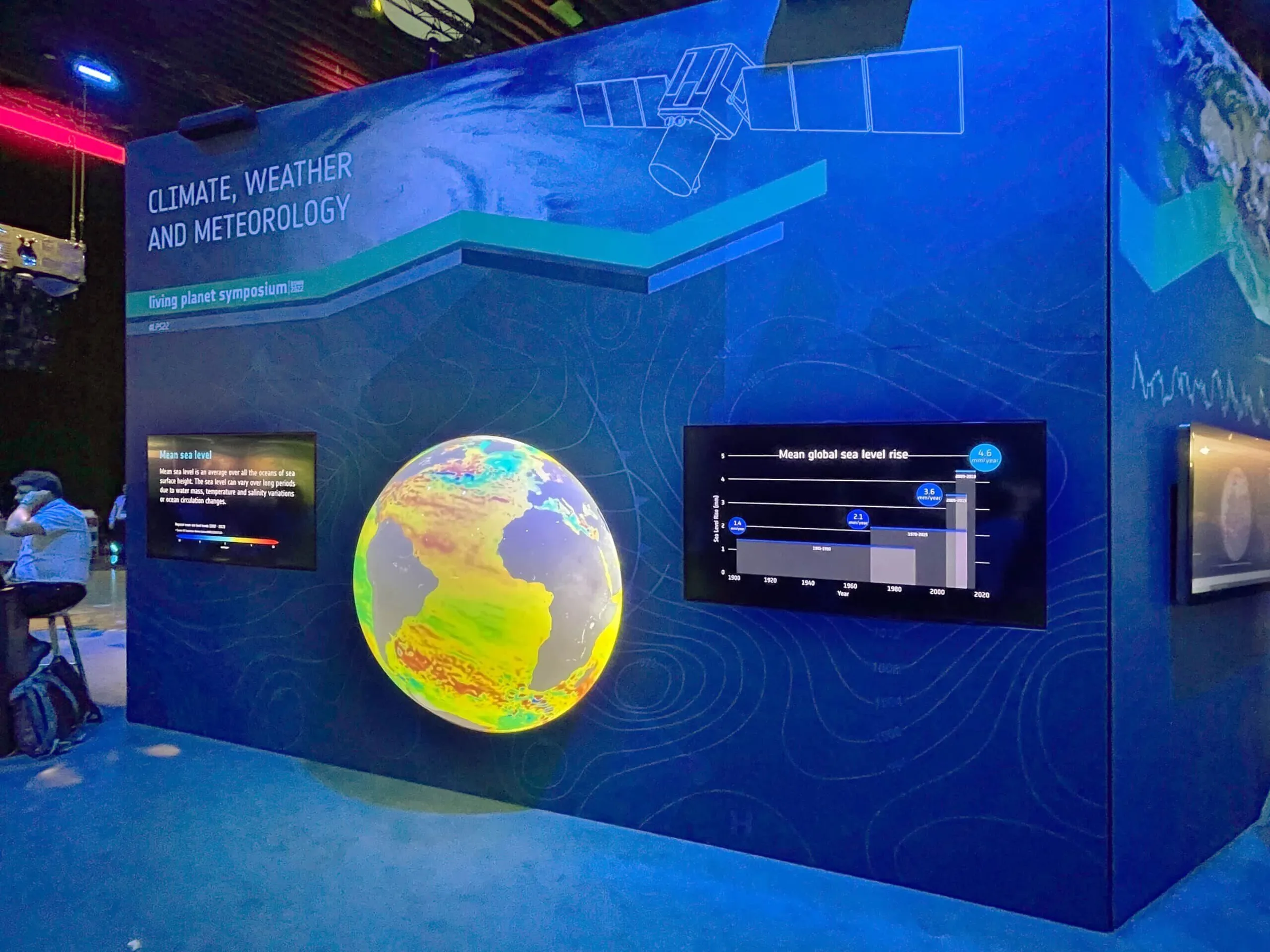
Interactive exhibition display featuring a 3D globe and integrated touchscreens
Frequently asked questions about interactive walls
What is an interactive wall?
An interactive wall combines a large-format visual display with touch, gesture and motion detection. Visitors can interact with digital content directly on the wall, explore it in a playful way or influence it through their movements.
How does an interactive wall work?
The content is displayed via touchscreens, LED modules or projectors. Touch sensors, cameras or LiDAR systems detect touches and movements and transmit this data to custom-developed software, which reacts immediately.
How much does an interactive wall cost?
The costs depend on the size, technology, design and scope of functions. The cost components include concept and planning, media production, software and CMS, wall construction and film application, hardware, installation, commissioning and project management. A reliable estimate can therefore only be provided once the specific requirements have been clarified.
How big can an interactive wall be?
Interactive walls can range from a single large-format touchscreen display to room-filling LED, video wall or projection solutions. The possible size is determined, amongst other things, by the room height, viewing distance, desired resolution and available installation space.
Does an interactive wall work even without being touched?
Yes. Cameras, depth sensors or LiDAR systems can detect people, gestures and movements without physical contact. This enables the wall to react to approaching visitors and adapt the content to suit their position or behaviour.
Which lighting technology is best suited to bright rooms?
High-brightness displays or LED walls are particularly suitable for bright environments. Projections, on the other hand, require controllable lighting conditions or high-performance projectors. The best solution depends on the ambient light, the size of the wall, the viewing distance and the desired image quality.
Can several people interact at the same time?
Yes. Multi-touch systems, as well as camera-based or LiDAR-based solutions, can detect several people and interactions simultaneously. This requires that the software, sensors and content have been specifically developed for simultaneous use.
Can the content be updated at a later date?
A content management system allows text, images, videos and topics to be updated or replaced at a later date. Extensive changes to workflows, animations or interactive features may require further customisation of the software.
Is an interactive wall suitable for trade fairs and showrooms?
Interactive walls are particularly well suited to trade fair stands, showrooms and interactive exhibitions. They create a striking visual impact from a distance, convey complex content in a clear and engaging way, and enable visitors to explore products or topics at their own pace.
How long do the design and installation take?
The duration of the project depends on its size, technical complexity and the scope of the specific content. In addition to on-site installation, consideration must also be given to concept development, technical planning, media production, software development, wall construction and testing. Early coordination with all trades involved shortens the implementation time.