
AI Solutions Room
AI becomes a spatial experience
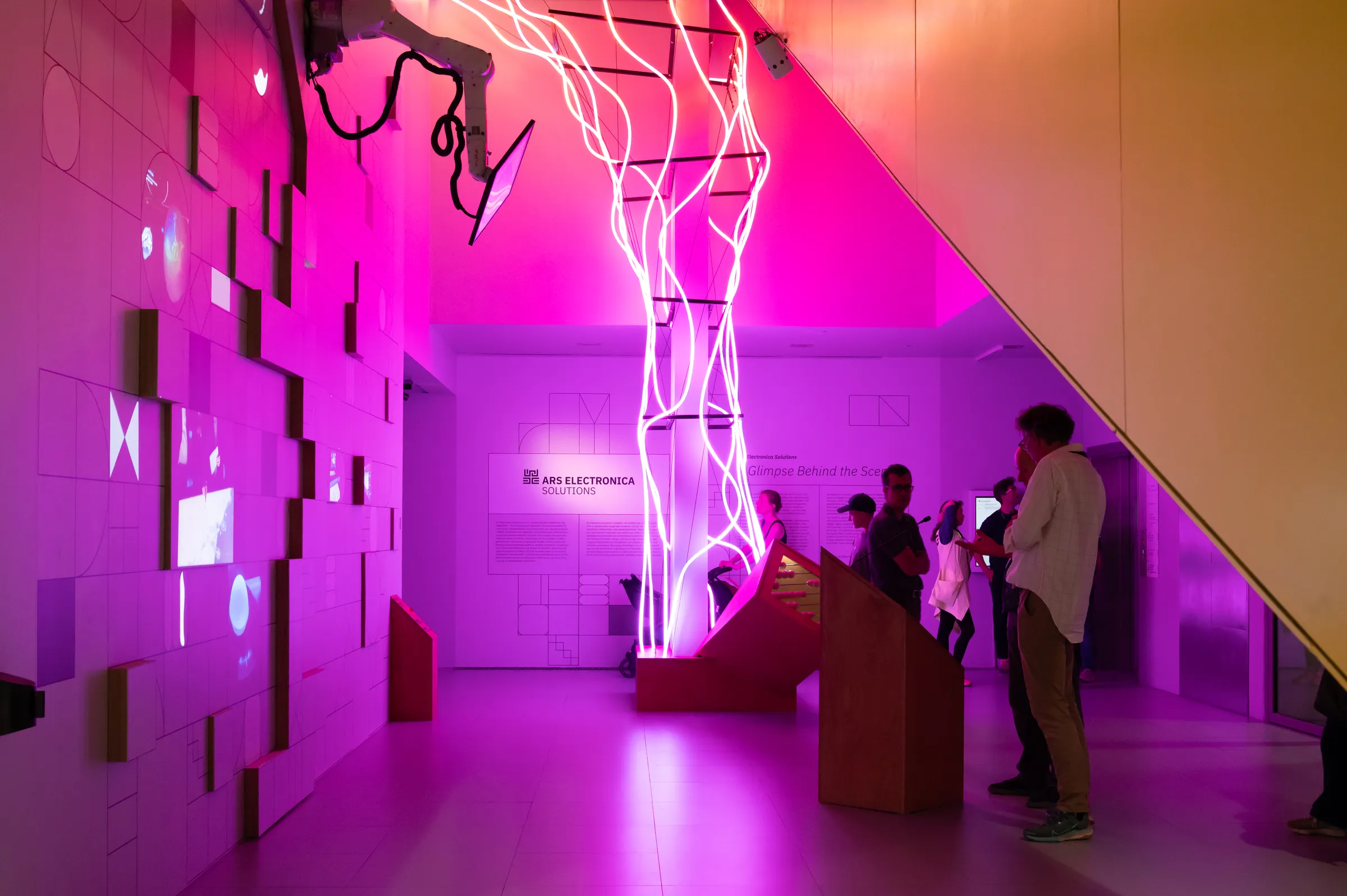
In the Solutions Room at the Ars Electronica Centre in Linz, visitors can ‘talk’ to an exhibition. An AI agent answers their questions, displays relevant project images and videos, and responds through speech, light and the movement of a robotic arm. This creates a personal connection to the projects, the team and the working methods of Ars Electronica Solutions.
Garamantis was involved in the entire exhibition area, from concept development through to implementation. Garamantis designed and developed the front-end applications for all stations, as well as parts of the software and AI interfaces. The Garamantis CMS links the project information to the interactive applications and serves as a knowledge base for the agents.
Discover global projects through personal dialogue
Ars Electronica Solutions develops and implements installations for companies and institutions worldwide. The Solutions Room brings this work to life at the Ars Electronica Centre: How are interactive experience spaces created? Who are the people and what technologies are behind them? And how are the installations supported and maintained after they open?
Visitors explore these themes through conversation and various forms of interaction. They ask questions, move abacus beads, pick up a ringing telephone receiver or have one of their own drawings interpreted by an AI. Each station offers a different perspective on the interplay between content, design and technology.
The Agent: a conversation to which the whole room reacts
The centrepiece of the Solutions Room is a large, wall-to-wall projection screen with tactile surfaces. At its centre is a KUKA robot arm fitted with a screen. An additional digital robot arm greets approaching visitors and draws their attention to the screen.
At a desk set up in front of them, they can speak to the AI agent via a microphone in German or English. A screen on the desk displays the conversation so far. The questions they ask determine which projects, team members or working methods they will learn more about.
The response unfolds across several media: the agent speaks, the screen responds, lighting sets the mood and the robotic arm moves. At the same time, relevant media content appears as projection mapping on the large wall. When discussing a specific project, for example, videos and project images can complement the conversation. If there are questions about the team, portraits of the relevant individuals are incorporated.
This transforms the agent into a physically present counterpart. Language, movement and visual content intertwine, turning the search for information into a multimedia encounter.
Quick replies despite a large knowledge base
Garamantis has developed a pipeline comprising various AI models for voice-based interaction. Speech recognition converts spoken questions into text, whilst speech synthesis makes the answers audible. In subsequent processing steps, project knowledge is accessed and supplementary content is selected.
One particular requirement was the minimal delay during the conversation. The agent responds very quickly, whilst information is gathered and processed in the background at the same time. This coordination facilitates a smooth exchange and combines an immediate response with the processing of extensive content.
The Garamantis CMS serves as a knowledge base, containing information on all projects. Project knowledge, speech processing, media selection and the applications within the room are linked via interfaces to external providers and to internal software. Content can be updated at any time via the CMS.
The system currently uses public APIs. At the same time, the infrastructure is designed in such a way that it would, in principle, also be possible to operate it using locally hosted services.
Abacus: Counting beads change the lighting ambience
The Abakus installation translates a familiar mechanical principle into a spatial light installation. Visitors move the abacus beads with their hands. A camera system detects their positions; the software translates these changes into an LED visualisation.
The LED strands wind their way from the abacus across the floor up to the ceiling. This means that the interaction extends far beyond the exhibit itself: any change to the beads alters the lighting atmosphere in the room. A small tactile intervention has an immediately visible, spatial effect.
Telephone box: A maintenance technician calls
Even the management of interactive installations becomes an experience in the Solutions Room. As soon as a motion sensor detects someone standing in front of the telephone booth, the phone rings. Whoever picks up the receiver speaks to an AI-based maintenance agent.
The agent talks about a project by Ars Electronica Solutions and invites visitors to have a chat. Visitors can ask questions and discuss the maintenance of interactive stations with him.
The telephone box thus brings to light an aspect of the work that often remains in the background when visiting an exhibition: the technical maintenance of the installations once they have been realised. The familiar telephone provides a simple way of engaging with this topic.
Baby Deep Space: Your own drawing opens up new applications
At Baby Deep Space, the interaction begins with a drawing by the visitors. A scanning unit from Garamantis captures the image. An AI model then analyses the drawing and selects suitable applications from the Deep Space catalogue.
The selected applications are displayed on a screen. In this way, your own idea becomes the starting point for discovering the possibilities offered by immersive experience spaces.
A tactile rotary dial on the screen completes the installation. By turning it, visitors trigger aesthetic visualisations and experience yet another direct link between physical input and digital response.
From concept development to coordinated spatial interaction
Garamantis helped develop all the stations in the Solutions Room and was responsible for their front-end software as well as the software and AI interfaces. There was considerable scope for creativity and design, particularly when it came to visualising the central agent.
A key technical challenge was synchronising the digital display on the robot arm’s screen with its movements. At the same time, the content on the projection screen had to be tailored to the conversation and the staging. The aim was to create a coherent interaction from several individually controllable components.
The concept was developed jointly over a period of several months. The subsequent implementation took three months. Garamantis worked closely with Ars Electronica Solutions, Peak Impact and Petros Kataras on the project. This collaboration built on the long-standing partnership with Ars Electronica.
An exhibition area that caters to its visitors
A typical tour begins with a welcome from the digital robot arm and a conversation with the central agent. Visitors then use the abacus to adjust the lighting, speak to the maintenance agent on the phone, and discover suitable applications for their own drawing at Baby Deep Space.
The Solutions Room demonstrates how AI can be integrated into a physical exhibition space. Conversations trigger relevant media, haptic inputs transform the space, and visitors’ own ideas unlock new content. The software developed by Garamantis combines these different approaches to create an exhibition that responds to its visitors in a personalised and multimedia-rich way.
Photos: Ars Electronica Solutions
Products used
Multitouch software
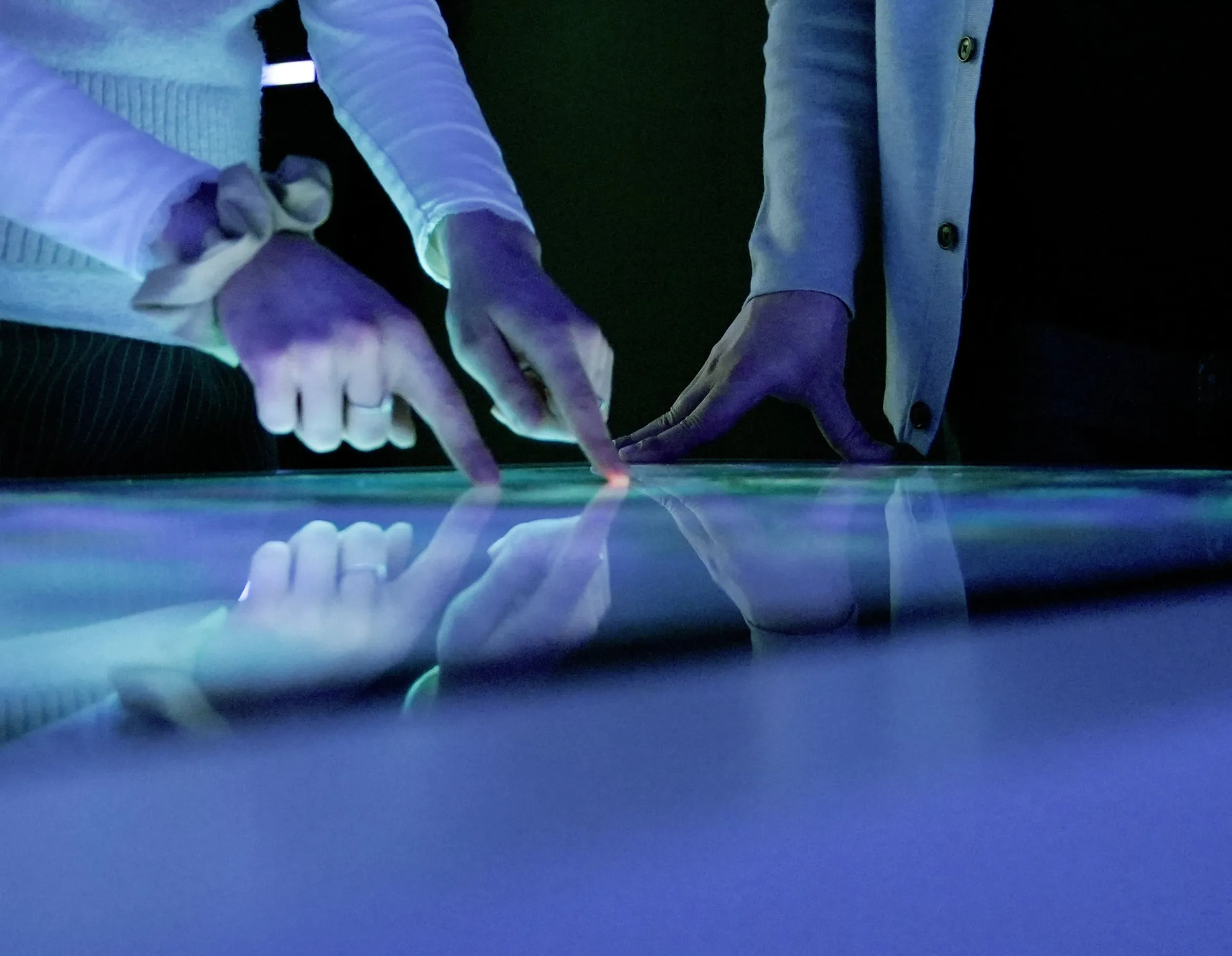
Explore products, customise scenarios and integrate media within a space: Garamantis develops bespoke multi-touch software using tried-and-tested modules – complete with suitable interfaces and content management.
Content Management System
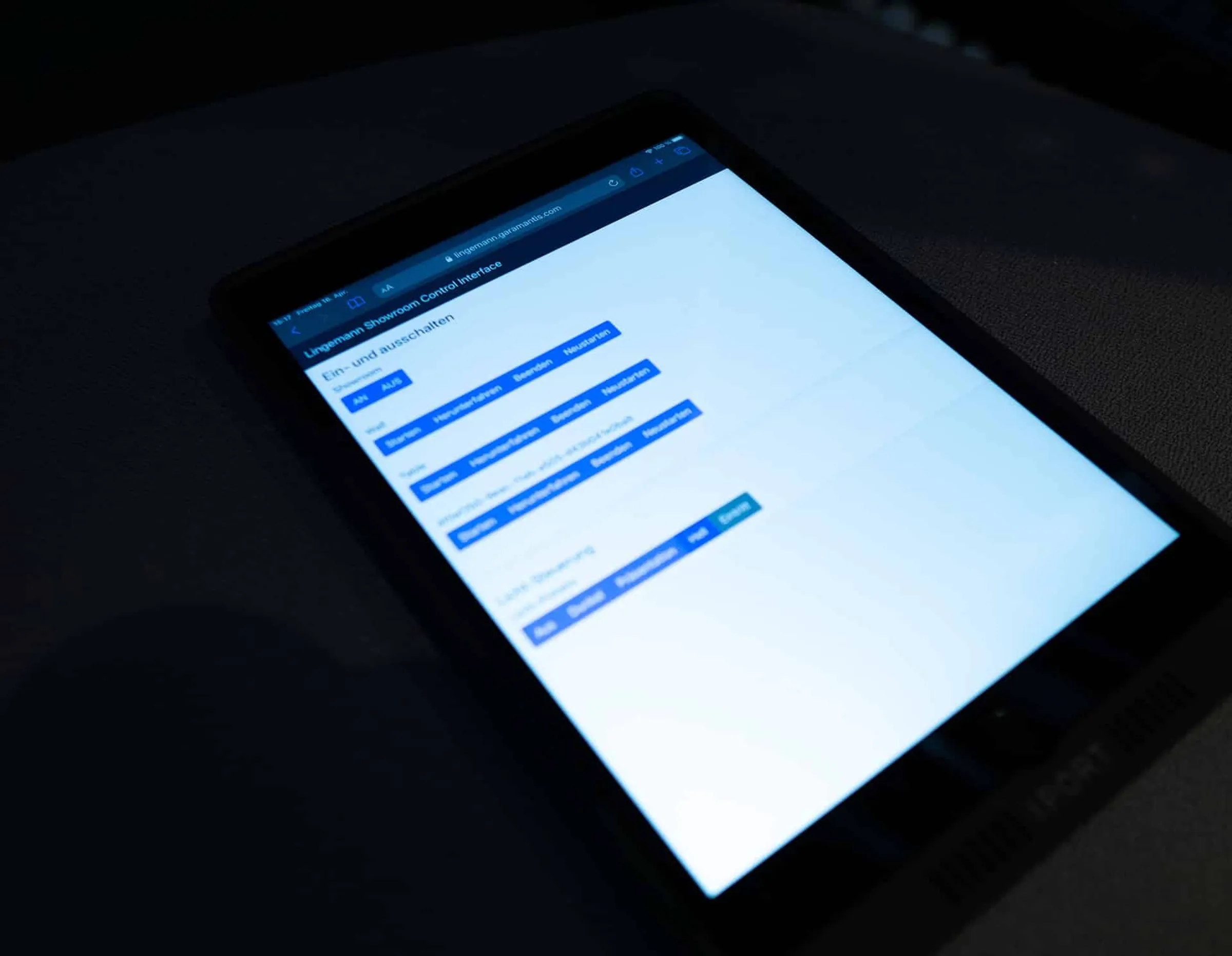
With the Garamantis CMS, you can update your interactive stations yourself – centrally via your browser and in line with your workflows.