
Immersive experience: definition, technology & examples
- Immersive spaces
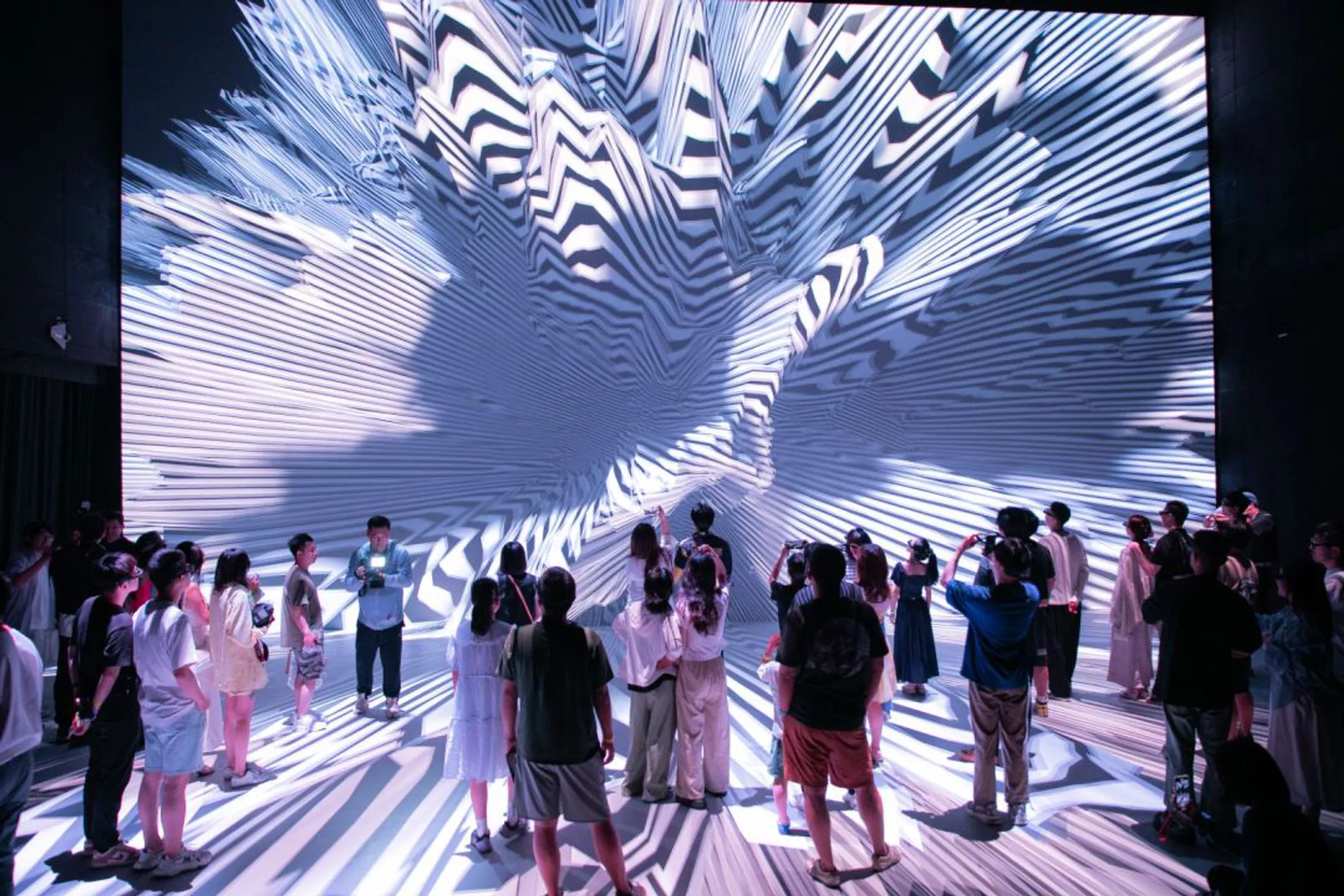
In an immersive experience, people don’t simply stand in front of screens. They are drawn right into the heart of the action. The space, content, interaction and technology intertwine in such a way that watching becomes participation – and a message is transformed into a lasting experience.
Here at Garamantis, we develop these kinds of immersive experiences for businesses, showrooms, exhibitions and visitor centres. Good immersion doesn’t start with a focus on the latest technology. It starts with a clear idea: what do we want visitors to understand, feel and do for themselves?
An immersive experience is created when a coherent narrative, spatial design, sensory stimuli and meaningful interaction come together to form a unified whole. Technology is not an end in itself, but rather enables the desired experience.
What is an immersive experience?
The term ‘immersion’ essentially means ‘to plunge into’. During an immersive experience, one’s everyday surroundings recede into the background for a certain period of time. People then feel as though they have been transported – spatially, emotionally or mentally – into a depicted world. This world can be entirely digital, entirely physical or a mixture of both.
In research, the terms ‘immersion’ and ‘presence’ are often closely linked, but are not entirely synonymous. Immersion primarily describes the characteristics and potential effects of a medium or system. ‘Presence’, on the other hand, refers to the subjective feeling of actually being ‘there’. The QUALINET White Paper on immersive media experiences provides an overview of these terms.
In practice, one thing is particularly important: a large screen or a pair of VR headsets alone are not enough to create immersion. Only when the setting, narrative structure, content and scope for action all come together can a credible experience be created.
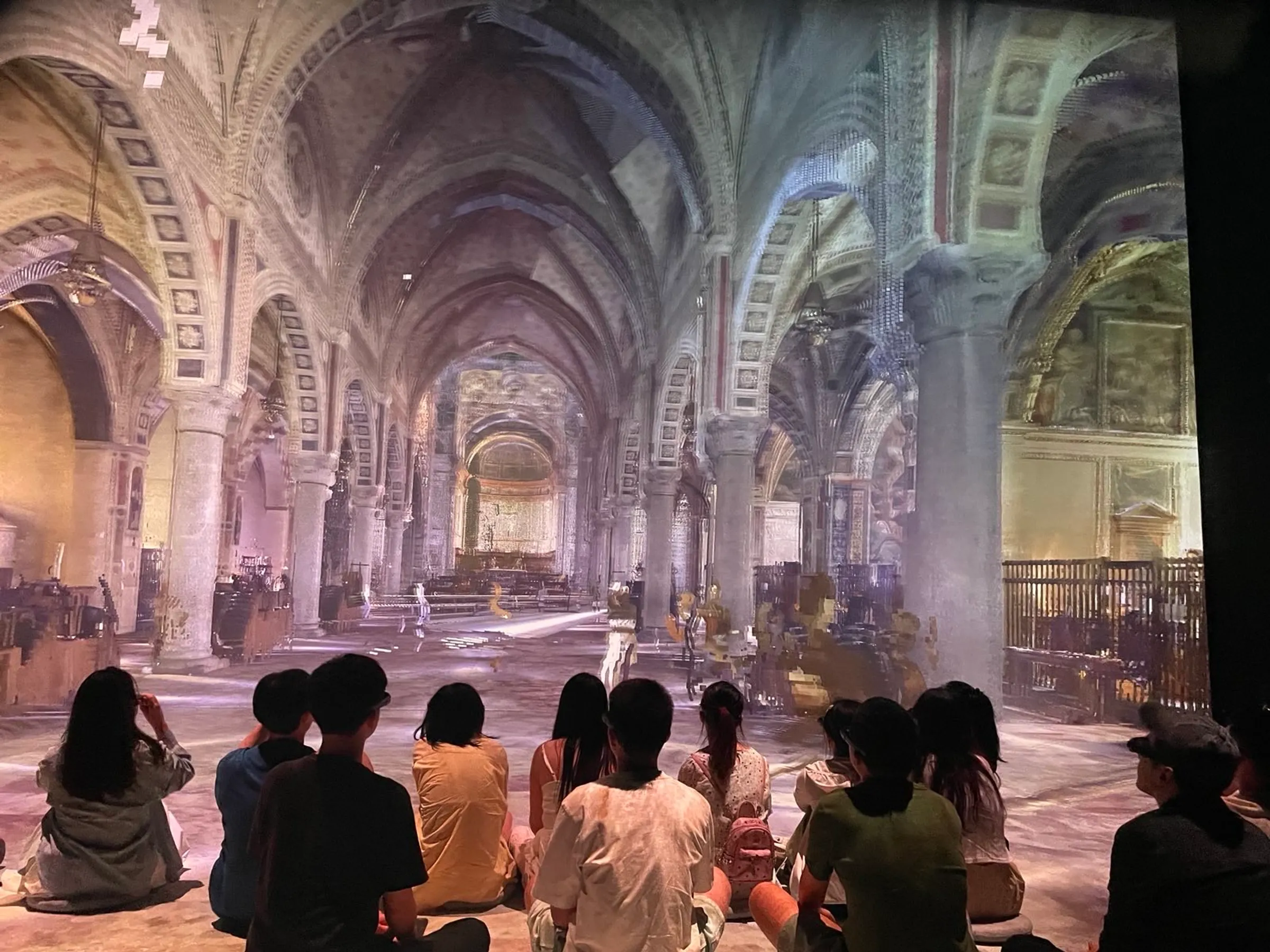
What creates an immersive experience?
1. A clear guiding principle
People find it easier to immerse themselves in a world if they understand what it is all about. A strong guiding principle links content, space and interaction. It answers the conceptual question ‘What are we showing?’ as well as the question ‘Why should this be relevant to our visitors?’
This is precisely why it is worth investing in a well-thought-out concept for interactive exhibitions and spaces. It ensures that individual technical highlights do not simply stand side by side without telling a shared story.
2. Space and scenography
Immersion is spatial. Lines of sight, walking routes, lighting, materials, projection surfaces and exhibits all influence how people perceive a story. The space can guide, surprise or open up new perspectives. A presentation is particularly effective when digital content does not appear artificial, but blends seamlessly with the architecture and the physical objects.
3. Relevant storytelling
You don’t need a Hollywood script to create an immersive experience. But it does need a narrative structure. This could be a journey through a product, a historical development, a future scenario or a problem-solving process presented in a spatial context. Good stories provide context for information and make complex topics more accessible.
4. Meaningful interaction
Interaction turns visitors into active participants. They can select content, move objects, alter scenarios, explore connections and make decisions together. It is crucial that every interaction serves a recognisable purpose. A flashing button does not in itself constitute an experience. An action that visibly triggers something, on the other hand, does.
5. Multisensory stimuli
Images and sound often form the basis. Depending on the concept, light, air movement, temperature, smell, touch or real objects may also be incorporated. The more senses are engaged, the greater the impact. It is essential that the stimuli complement one another and do not clash.
6. Technology that is invisibly reliable
Ideally, the technology should be barely noticeable during the experience. Software, sensors, media servers, audio, lighting and hardware should respond quickly, reliably and intuitively. For subsequent operation, maintainability, content updates and clear fallback procedures are also important. An immersive space must not only impress at its opening, but also function reliably in day-to-day use for years to come.
Which technologies create immersive experiences?
Immersion is not synonymous with virtual reality. Depending on the target audience, location and usage scenario, a wide variety of technologies may be suitable. Often, the most effective solution arises from a clever combination of these.
Technology
Typical building blocks
Particularly suitable for
Immersive projection room
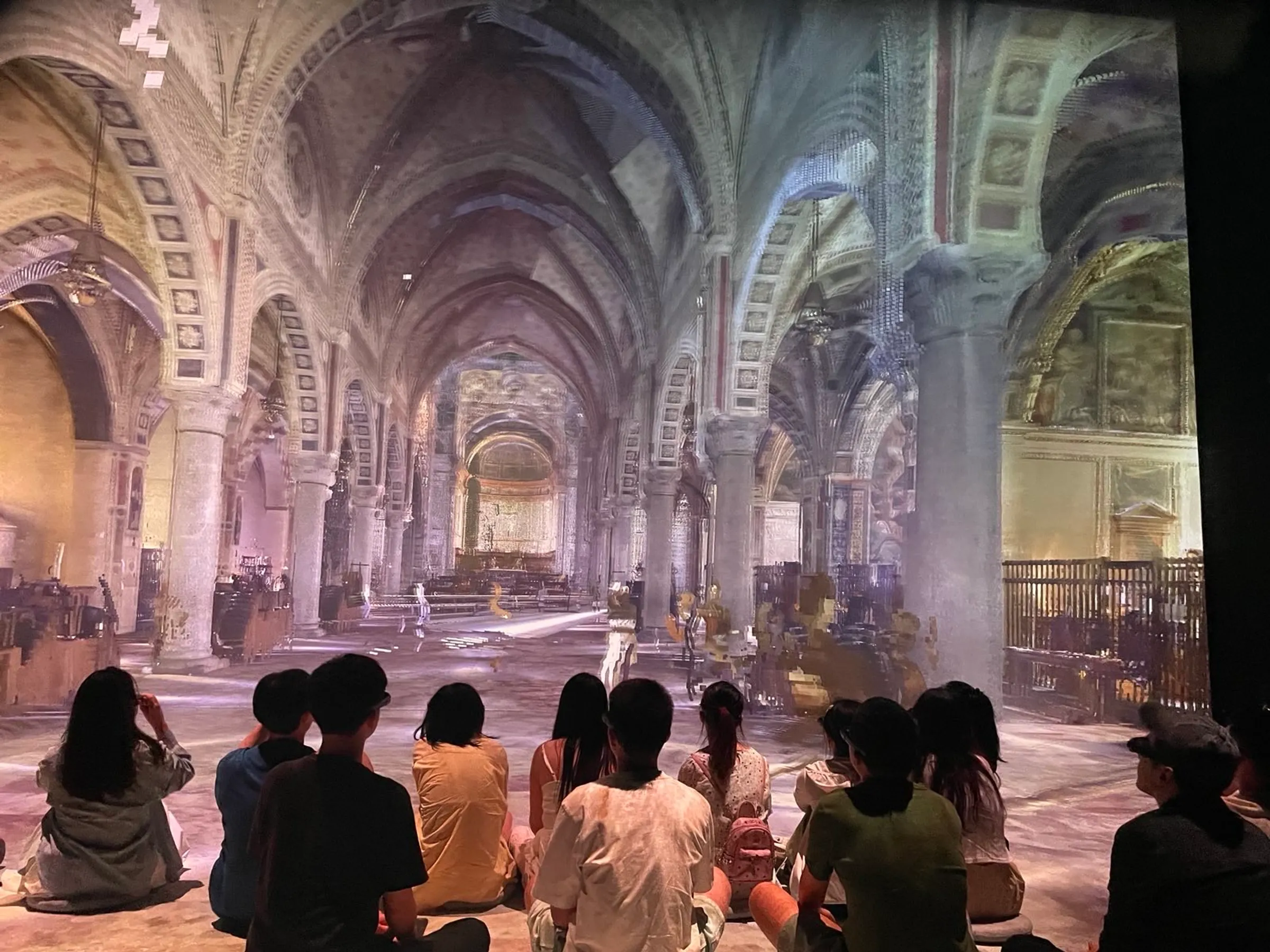
Wall/floor projection, audio, lighting, sensors
A shared group experience without a headset; a strong sense of spatial immersion
Virtual Reality
Headset, tracking, controller or hand tracking
Fully digital locations, facilities, simulations and perspectives
Augmented / Mixed Reality
Digital layers superimposed on the real world
Expanding real products or spaces in context
Projection mapping
Pixel-accurate projection onto buildings or objects
Telling stories about and transforming physical spaces in a dynamic way
Multitouch & Tangibles
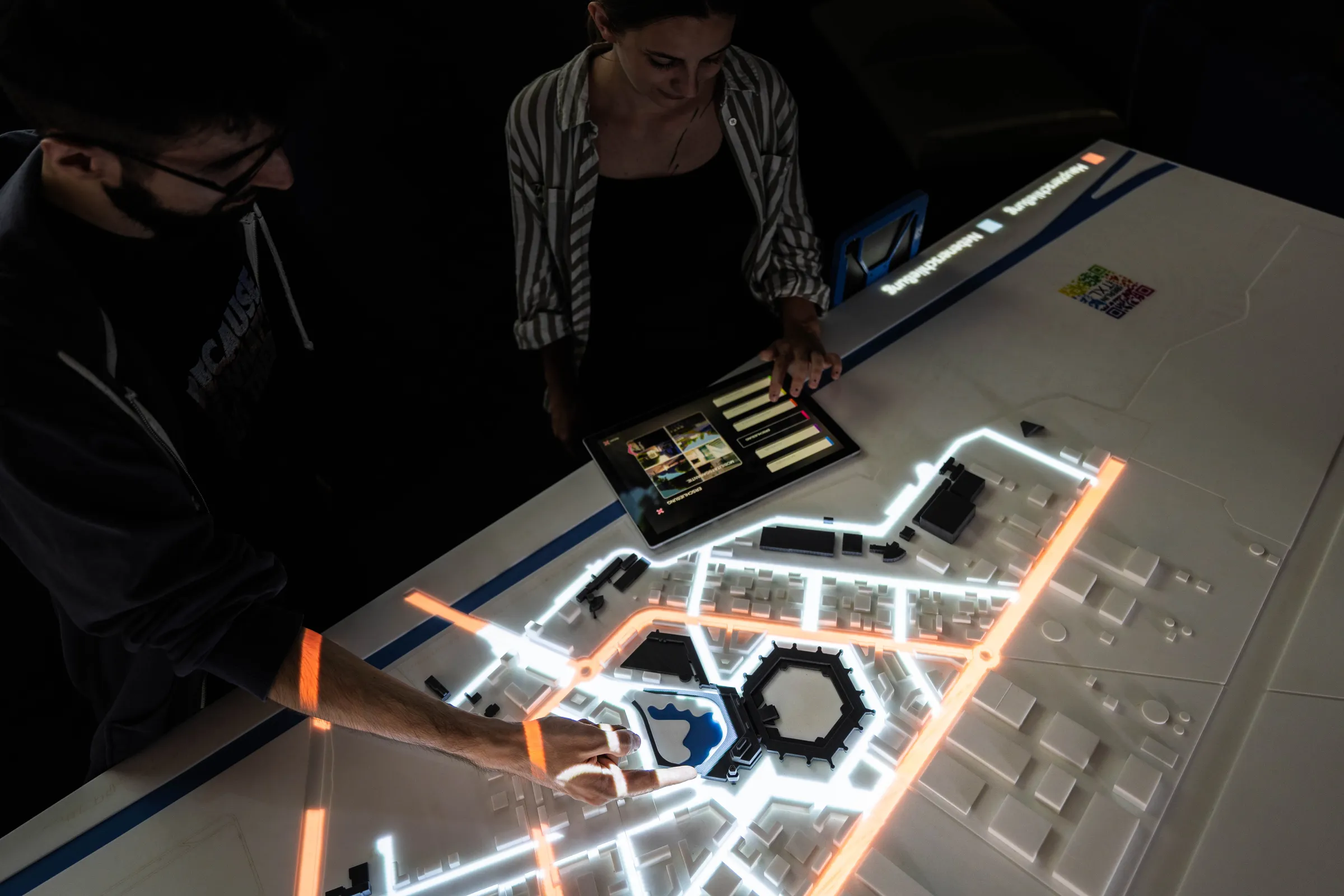
Touchscreens, tables, object recognition
Exploring content independently or together
Spatial Sound & Sensory Perception
3D audio, cameras, lasers, motion detection
Guidance, atmosphere and immediate response to behaviour
An immersive space can, for example, combine projections, spatial audio and gesture control. An interactive projection links digital content with walls, models or real exhibits. Virtual reality is particularly suitable when people are to be immersed in hard-to-reach locations, large-scale facilities or entirely digital scenarios.
Where an immersive experience is particularly useful
Corporate showrooms and brand spaces
Interactive corporate showrooms allow products, processes and innovations to be presented in a way that is easy to understand, even if they are too large, too complex or not yet physically available. Visitors can explore content in greater depth according to their interests and experience a brand not just through slides, but within the space itself.
Interactive exhibitions and visitor centres
An interactive museum or digital exhibition can convey knowledge on several levels: it can be easily grasped by curious visitors and offer more in-depth insights for those with prior knowledge. Immersive media help to bring history, science, culture or future-oriented topics to life in a spatial way, without overshadowing the original or the substance of the content.
Trade fairs and roadshows
At a trade fair, an experience must first attract attention and then convey a relevant message. Interactive trade fair installations can visualise products, spark conversations and present content tailored to individual visitors. The best solution combines visual impact with an interactive experience that remains intuitive to use even when visitor numbers are high.
Immersive experiences from our practice
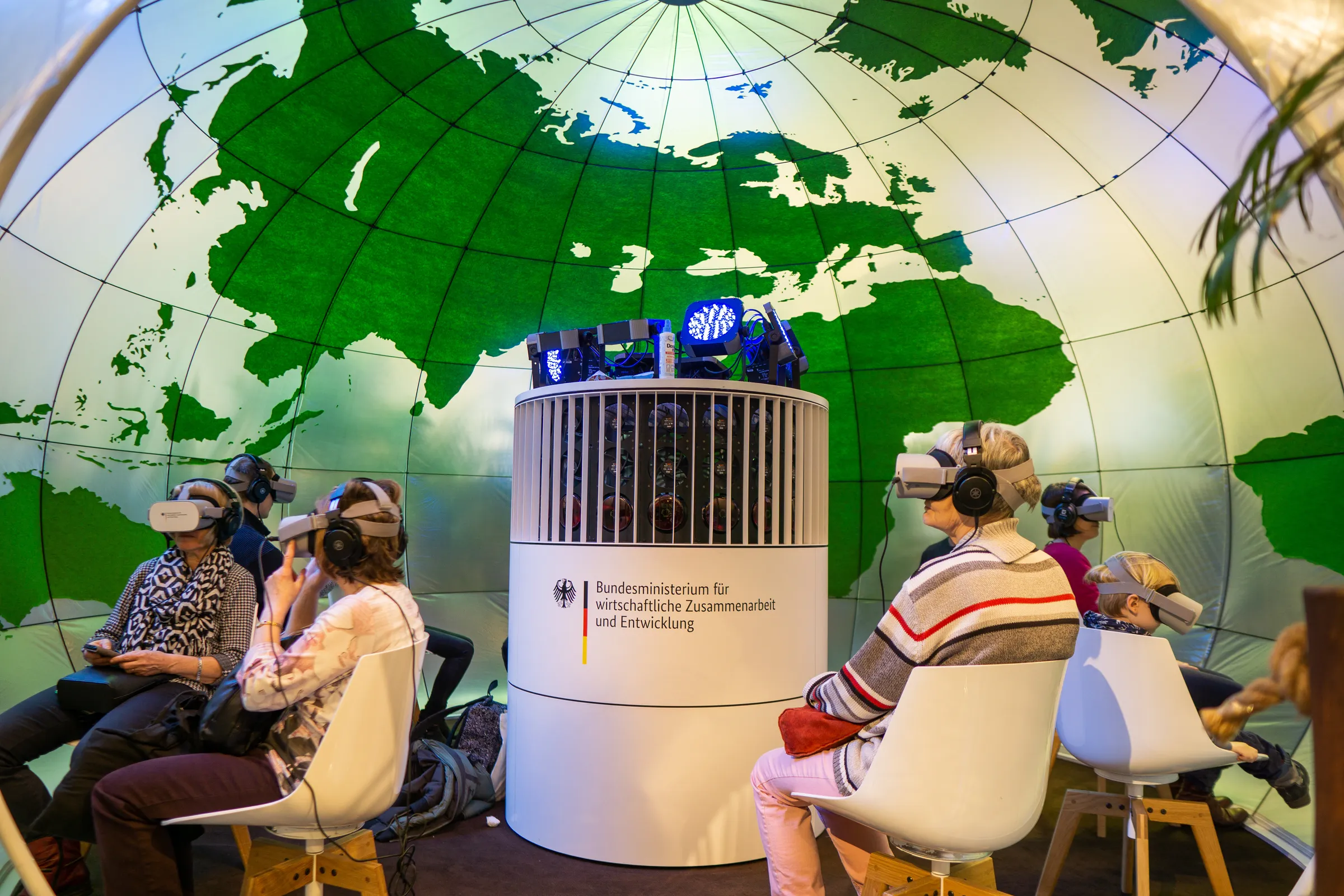
A good example of multisensory immersion is the 360-degree climate dome. There, VR images are combined with real sensory impressions such as air, temperature and smells. In this way, climate change is not only explained, but can also be experienced as a shared group experience.
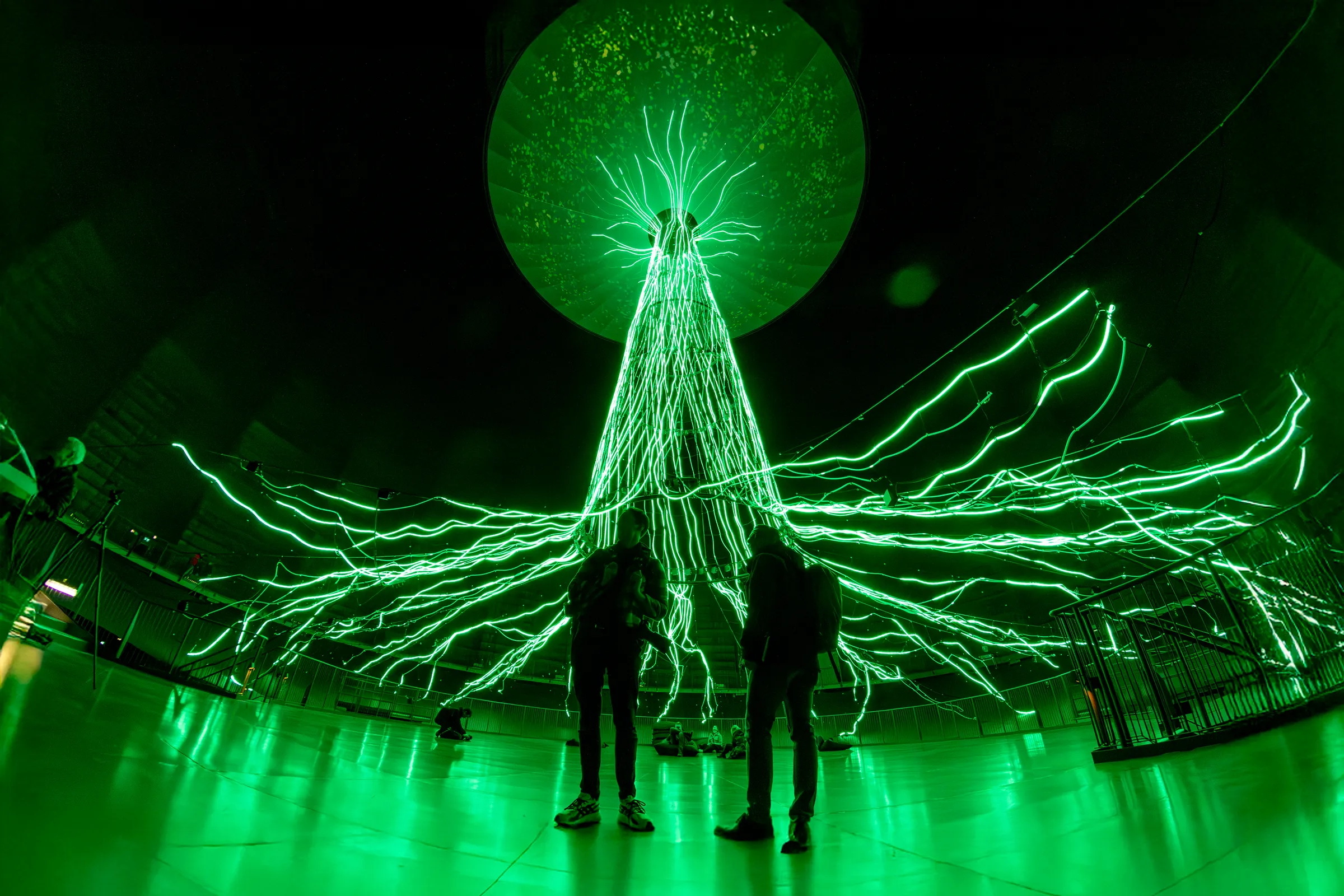
In the immersive light sculpture ‘The Tree’, visitors can stand and move around inside an oversized, digital tree. This monumental tree towers over the entire space, combining light, projections and music to create an immersive experience. Garamantis developed the real-time production software, designed the experience logic and implemented the system logic in such a way that the large-scale technical structure can be precisely controlled.
From the ‘wow’ factor to real impact: seven planning questions
Immersive technology can capture people’s attention. However, a lasting impact can only be achieved through a clear concept. These seven questions should therefore be asked at the start of every project:
- What specific communication or business objective is the experience intended to support?
- Which target groups attend, in what circumstances, with what prior knowledge, and how much time do they have?
- What is the key message that visitors take away with them?
- What role do visitors play: observing, discovering, deciding, shaping or collaborating?
- What kinds of approaches and technologies can help the story?
- How is content updated, how are systems maintained, and how are faults dealt with?
- Once we’ve got started, how can we tell if the experience is working?
Our workflow, from experience strategy through to day-to-day operations,links these questions to design, software, systems integration, testing and support.
How much does an immersive experience cost?
The honest answer is: it depends on the concept. An interactive single module is priced differently to a fully equipped room featuring multiple projections, real-time software, sensor technology, bespoke construction and bespoke content.
The main cost drivers are:
- Size, layout and structural requirements of the room
- Type and number of projectors, displays, sensors, audio and lighting components
- Scope of the custom software and experience logic
- Production or editing of 2D, 3D, video and audio content
- Interfaces with existing systems and content management
- Installation, maintenance and operation
A robust concept provides clarity at an early stage as to which elements are essential to the project’s success and where effort or the required hardware can be reduced without compromising the idea.
Taking accessibility, comfort and operational considerations into account
An immersive experience should reach as many people as possible. That is why accessibility and comfort must be built into the design. The W3C document on accessibility requirements in XR describes, amongst other things, the need for multimodal access, customisable input methods and alternative forms of presentation.
In practical terms, for immersive projects, this means:
- Make provision for subtitles, accessible language and alternative audio or text options
- Do not control interactions solely through a single gesture, posture or sensory modality
- Take into account both seated and standing use, as well as different body heights
- Consciously designing movement, changes in lighting, sound levels and VR comfort
- Provide clear onboarding guidance and ensure that options for leaving are always clearly identified
- Monitor technical statuses and ensure clear fallback procedures are in place in the event of a fault
How can the impact be measured?
The success of an immersive experience depends on its purpose. A visitor centre assesses success differently from a sales showroom. Rather than simply counting visitor numbers, it is worth using a combination of observation, system data and direct qualitative feedback.
- Attention: How many people enter or start the interaction?
- Usage: How long do they stay, what content do they choose, and where do they drop off?
- Comprehension: Can they summarise the main message afterwards?
- Engagement: How many functions, perspectives or scenarios do they explore?
- Conversion: Are conversations, leads, appointments or specific next steps being generated?
- Operations: How stable is the system, and how quickly can content be updated?
It is important to define the metrics at the concept stage. This enables the experience logic to provide targeted data without unnecessarily complicating the experience.
An immersive experience does not begin with technology, but with the concept
The most compelling experiential environments are created when space, content, interaction and system design are conceived together from the very outset. Then technology becomes an invisible enabler: it allows walls to respond, models to tell stories, data to come to life and people to interact with one another.
Garamantis combines creative conception, design, prototyping, engineering and bespoke software development within interdisciplinary teams. Our approach is underpinned by many years of project experience, our collaboration with Ars Electronica and a robust process from the initial idea right through to operation. You can find out more by exploring our team and our case studies.
Dieser Inhalt wird von einem Drittanbieter gehostet. Durch das Anzeigen des externen Inhalts akzeptieren Sie die Nutzungsbedingungen von youtube.com.
FAQ on the immersive experience
What is an immersive experience?
An immersive experience is an experience designed with spatial and dramatic elements that engages participants so deeply that they feel as though they are part of the action. Possible elements include projections, sound, lighting, interaction, and virtual or augmented reality.
Does an immersive experience always require a VR headset?
No. Immersion can also be achieved without a headset, for example through room-filling projections, interactive walls, spatial sound, lighting, sensors and a coherent presentation. The most suitable technology depends on the target audience, the venue and the communication objective.
What is the difference between interactive and immersive?
Interactive means that people can interact with content. Immersive means that they feel drawn into an experience physically, emotionally or mentally. An installation can be interactive without being particularly immersive. It is particularly effective when interaction and immersion complement each other.
In which areas are immersive experiences suitable?
Immersive experiences are suitable for corporate showrooms, visitor centres, trade fairs, brand spaces and foyers, amongst other venues. They are particularly useful when complex content needs to be made understandable, products need to be experienced without a physical specimen, or messages need to be conveyed in an emotive way.
How long does it take to develop an immersive experience?
The duration depends on various factors: the space, the content, customisation, software, hardware and the trades involved. A single exhibit can usually be planned more quickly than a networked experiential space. However, a robust concept with clear responsibilities and approval processes provides planning certainty at an early stage.
How much does an immersive experience cost?
Flat-rate prices are not very meaningful. Key factors include the size of the room, the projection or display technology used, the sensor technology, bespoke software, content production, structural integration and operational requirements. An early concept helps to strike a sensible balance between impact, scope and budget.