
Immersive: Meaning, definition and examples
- Immersive spaces
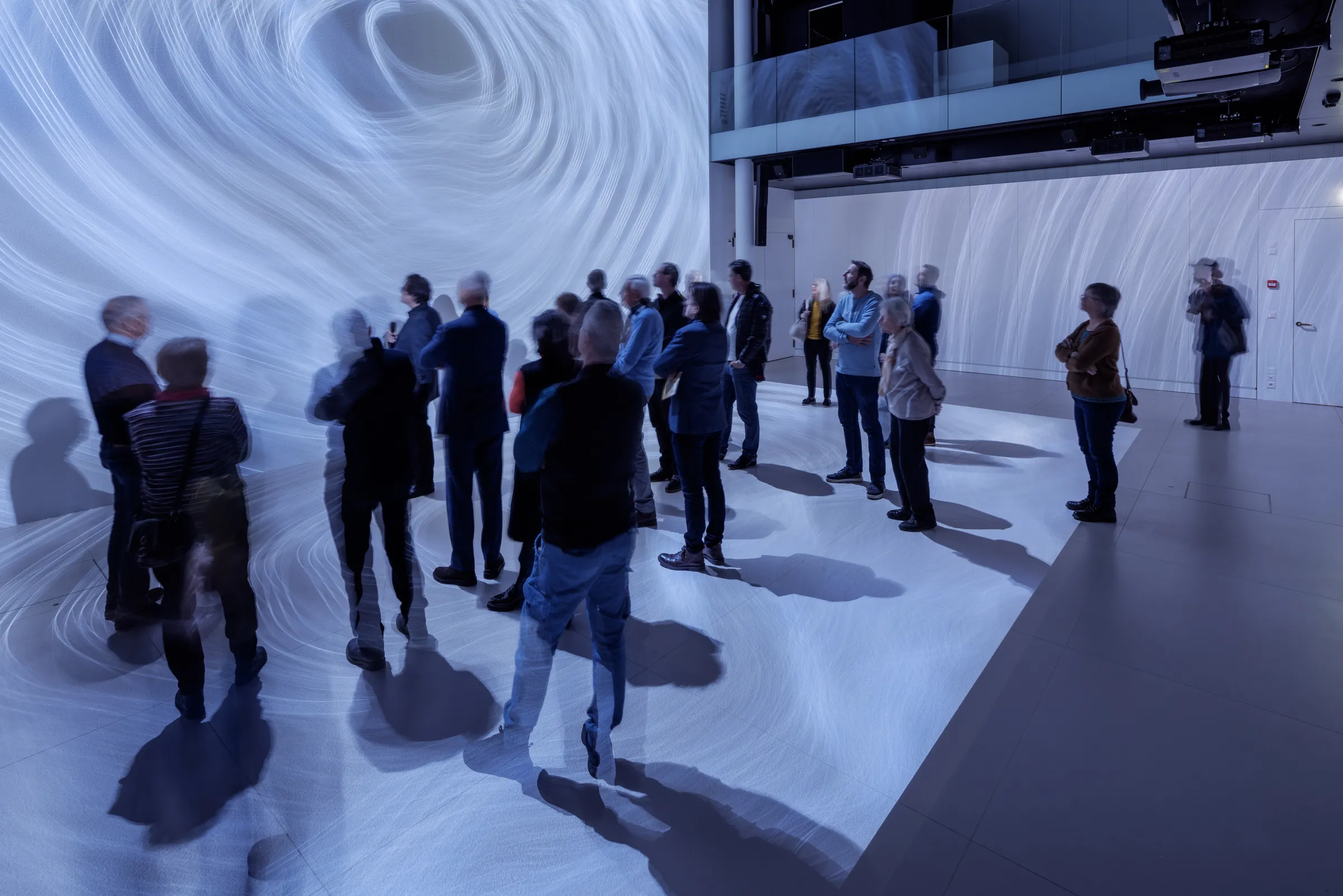
A medium, a space or an experience is described as immersive when it engages people’s senses so intensely that their real surroundings fade into the background and they feel as though they are right in the thick of the action. The word is derived from ‘immersion’, which means ‘to plunge into’. An immersive experience can be created through spatial vision, spatial sound, interaction, storytelling or virtual reality. VR headsets are not strictly necessary for this.
What does ‘immersive’ mean?
The short definition is as follows: something is immersive when it fully engages the senses and creates the feeling of being part of a depicted or artificially created world. The Duden dictionary describes ‘immersive’ as based on immersion or causing immersion.
It is not just what people see that matters. A good immersive experience arises from the interplay of space, visuals, sound, movement, interaction and a credible narrative. The more harmoniously these elements interlock, the less the experience feels like a presentation from the outside – and the more it feels like a situation in which you yourself are present.
In specialist literature, immersion and presence are often closely linked, but are not considered entirely synonymous. Immersion primarily describes the characteristics of a medium or system that enable the audience to become immersed. Presence refers to the subjective feeling of actually being ‘there’. Put simply: the production creates the conditions; the audience experiences the effect. A comprehensive overview is provided by the QUALINET White Paper on Immersive Media Experience.
What is immersive – explained simply?
Imagine an ordinary room. An underwater landscape appears on the walls, the floor reacts to your footsteps, you hear spatial sound as if a whale were swimming past behind you, and the projection changes as soon as you move. The room itself, however, remains unchanged. Yet your perception tells you a different story.
That is precisely what the immersive effect is all about: you are not just looking at a picture of the ocean, but experiencing the environment as if you were part of it. Ideally, the technology fades into the background, leaving you to focus on the experience. At best, projectors, sensors and speakers are imperceptible. They operate in the background so that the story in the foreground feels authentic.
A deep immersion can also work without digital technology. A densely told novel, a gripping film, a role-playing game or a theatre production can likewise captivate people so thoroughly that time and surroundings briefly become irrelevant. Digital technologies can enhance this effect, particularly in terms of spatial immersion, multisensory engagement and interactivity.
How can you tell if an experience is immersive?
Not every large-scale projection automatically transports people to another world. And not every technically sophisticated installation is compelling. Such experiences usually arise from a combination of several of the following characteristics:
An environment that incorporates the field of view
Large-format projections, LED screens, 360-degree images or VR headsets minimise visible breaks with the real environment. The fewer distracting edges, cables or controls that are visible, the easier it is to create the impression of a cohesive world.
Spatial sound and the right atmosphere
Sound can convey direction, distance and movement. Footsteps behind the audience, a sound overhead or a bass note that can be felt throughout the room enhance the sense of space. Light, temperature, air movement or scent can further enrich the experience.
Interaction and immediate response
When an environment responds to movements, touch or decisions, observation turns into participation. The audience influences the course of events and experiences the consequences. Interaction is not essential for immersion, but it can significantly enhance it.
A credible story
A clear narrative structure links information, emotions and actions. It answers the questions: Where am I? What can I do? Why is this relevant? Without this logic, even a spectacular space quickly becomes nothing more than a collection of impressive effects.
A coherent overall system
Immersion is broken when the picture and sound are out of sync, interactions are delayed, or the controls need to be explained as if they were on a remote control. Good systems feel immediate, stable and intuitive. The audience should be able to focus on the content – not on the technology.
Immersive, interactive and virtual: what’s the difference?
These terms are often used interchangeably, but they do not mean the same thing. The following overview helps to make sense of the jumble of terms:
Term
Key question
Meaning
Example
immersive
How deep do I go?
It gives you the feeling of being right in the thick of things.
360-degree projection, VR experience
interactive
Is there anything I can do to make a difference?
Responds to inputs, movements or decisions.
Multitouch table, use of sensor technology
virtual
Is the environment digitally generated?
Describes digital objects or worlds.
3D model, virtual environment
multisensory
Which senses are involved?
Appeals to several senses at once.
Sight, sound, wind and smell
An interactive multi-touch table can therefore be very easy to use without the whole room being designed to be immersive. Conversely, a 360-degree projection can be highly captivating, even though the audience has no influence over the sequence of events. Experiences often become particularly intense when spatial design and meaningful interaction come together.
Which technologies can create an immersive experience?
Virtual Reality
Virtual reality replaces the visible real-world environment with a digital world. Head movements change the viewing angle in real time, and hand-tracking or controllers are often used as well. VR is particularly well suited to individual perspectives, simulations, virtual journeys and situations that would be physically inaccessible or only accessible with considerable effort. The major drawback is the ‘isolation’ of the user whilst wearing VR headsets. You can find out more in our section onVirtual Reality for Businesses.
Augmented and Mixed Reality
Augmented reality supplements the real-world environment with digital content. Mixed reality takes this a step further: real and digital objects can interact spatially with one another or complement each other. The immersion is usually less intense than in VR, as the physical world – and therefore one’s sense of orientation – remains visible. In return, information can be linked directly to real products, places or exhibits.
Immersive spaces and projection systems
Spatial projections integrate walls, floors, ceilings or additional surfaces into a single image. Visitors can move around freely, do not need glasses and can share the experience as a group. We have been working on large, highly interactive projection systems since 2009. On our page dedicated to immersive spaces, we demonstrate how projection, sensor technology, real-time software, sound and interior design work together. As immersive spaces involve a huge amount of work and are not available for home use, this type of immersion is a truly special experience.
Interactive exhibits and multimedia installations
Multitouch walls, interactive display cases, rotating screens, sensor panels or networked exhibits can all form part of a spatial narrative. They not only make content visible, but also allow it to be controlled. It is crucial that the interaction does not feel out of place, but rather advances the narrative in a logical way. These can be described as particularly captivating exhibits.
Practical examples from our projects
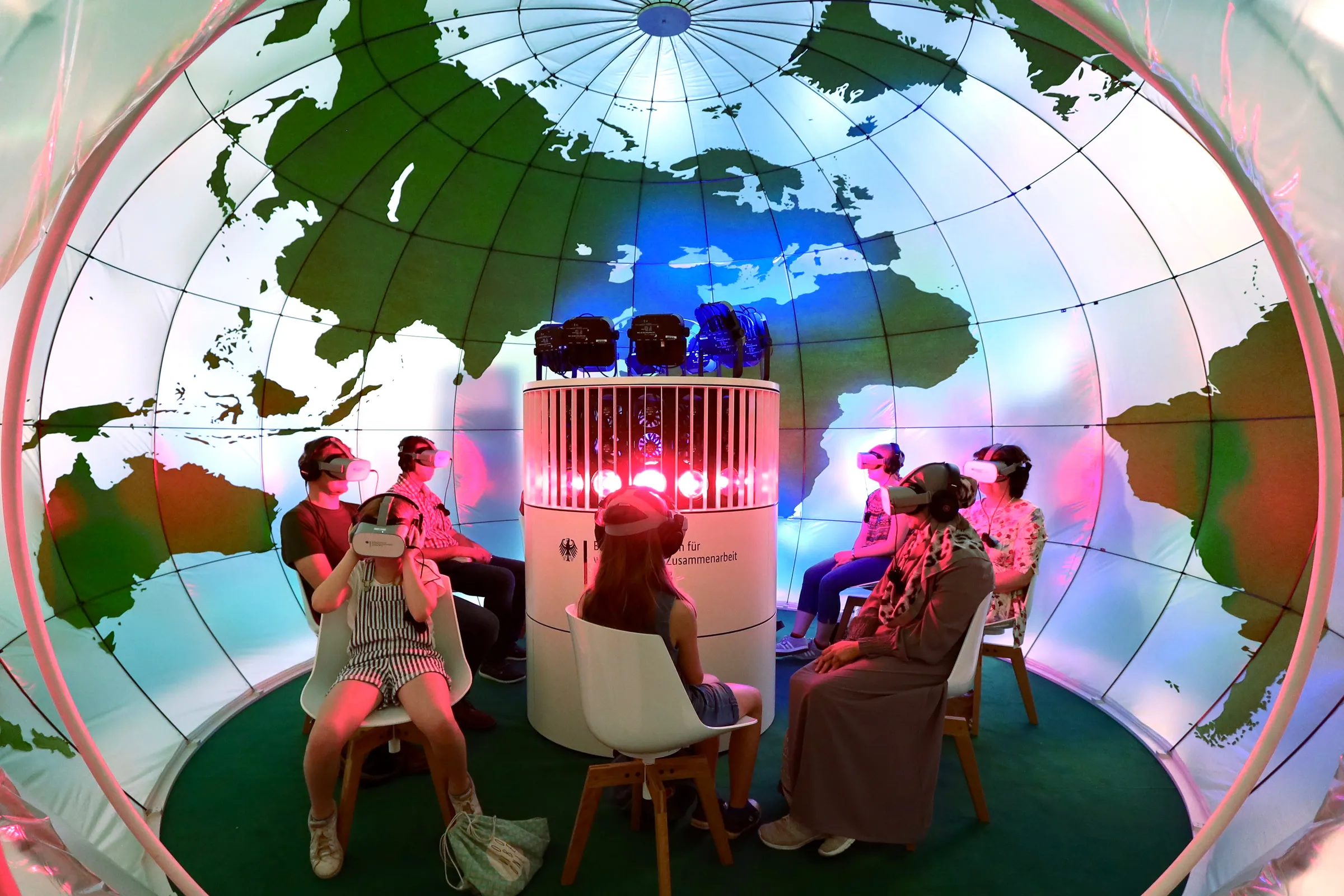
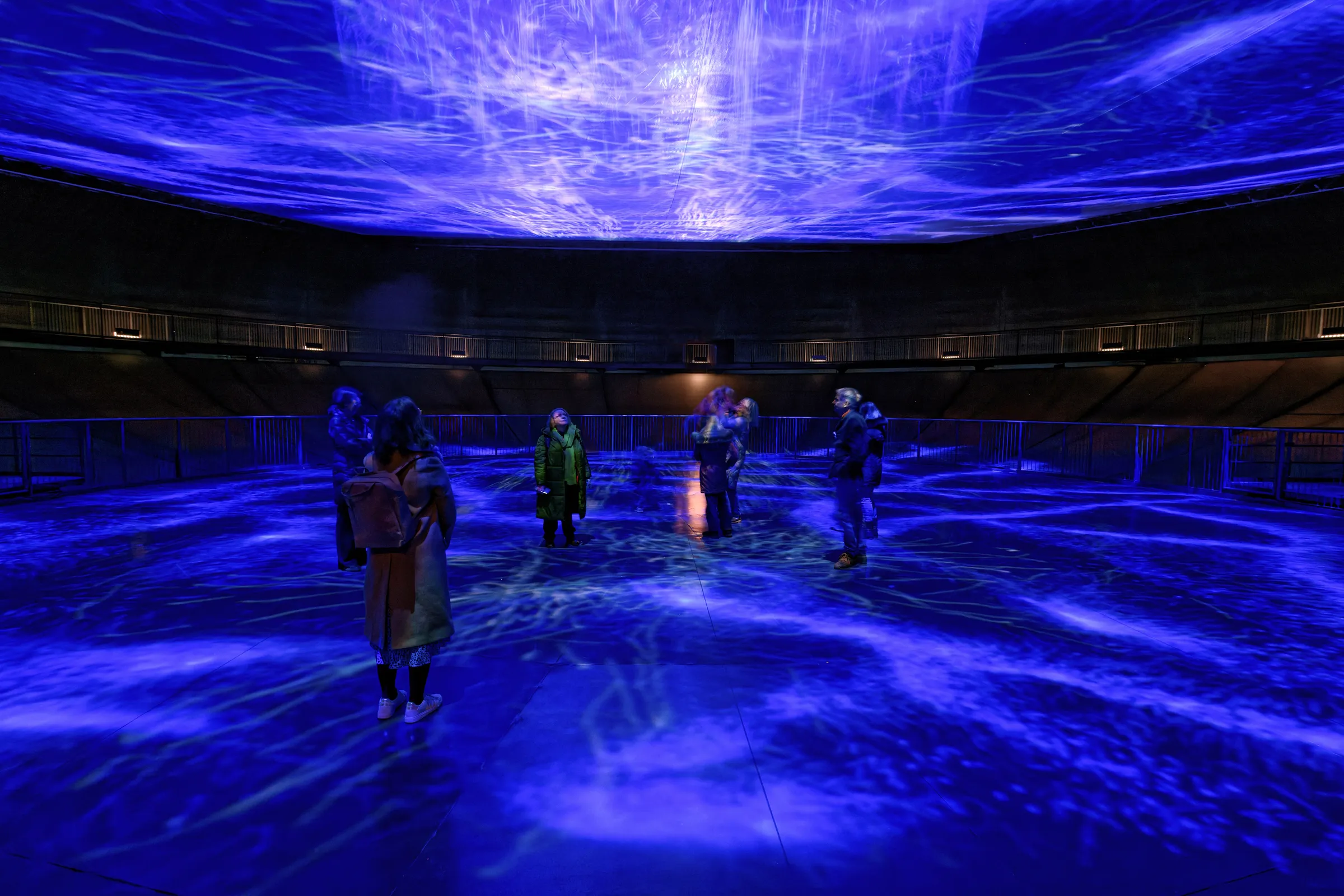
The spectrum ranges from the 360-degree climate dome with synchronised VR headsets, wind, heat and scent, to the immersive underwater world at the Oberhausen Gasometer,featuring a projection surface of more than 1,000 square metres.
Both examples show that the effect is not created by a single device, but by the precise interplay of content, space, software and sensory impressions.
Where are immersive experiences used?
Museums and interactive exhibitions
In museums and exhibitions, immersive media can bring historical sites, natural phenomena, works of art or scientific processes to life in a spatial way. Projections, sound, interaction and physical exhibits offer different ways of engaging with a topic. Visitors can choose for themselves how deeply they wish to immerse themselves.
Corporate showrooms and brand spaces
Complex products cannot always be transported, opened or demonstrated in all their variations. In an interactive corporate showroom, companies can showcase machinery, products and future scenarios in a way that is both clear and impressive. The presentation becomes a cohesive brand experience when the space, content and interaction are brought together under a single, coherent concept.
Learning, training and simulation
Immersive learning environments enable learners to explore situations, make decisions and practise procedures. This can take place in a VR simulation, a projection room or an interactive application. This approach is particularly useful when real-world exercises are expensive, rare, dangerous or difficult to organise.
Entertainment, Games and Culture
Games, films, theatre, concerts and art installations use immersion to engage the audience emotionally. The effect can arise purely from the narrative, or be enhanced by space, sound, movement and interaction. The boundaries between the audience, the stage and the digital world are deliberately blurred.
How do you create a good, immersive production? 4 tips based on ten years’ experience:
The most expensive technology is not necessarily the best solution. A good immersive experience therefore does not begin with the question of an LED screen’s pixel pitch, but with the desired effect.
1. Target audience and usage context first
Who will be entering the room? How long will people stay? Will they experience the installation on their own, in groups or during a guided tour? Does the content need to be available in several languages? These conceptual questions determine how open, guided or interactive the experience should be.
2. Develop a clear experience logic
An immersive experience needs a clear structure. Attention, orientation, immersion and conclusion should be carefully designed. Every interaction requires clear feedback. Every media screen needs a purpose. Otherwise, the ‘WOW’ quickly turns into a ‘WHAT FOR?’.
3. Planning the space, content and technology together
Immersion arises at the points of transition: between projection and architecture, between touch and response, between sound and movement. For this reason, spatial design, storytelling, the interface, software and hardware should not be conceived and developed in succession, but rather as an integrated system.
4. Taking operation and updates into account
An interactive exhibition space must function effectively not just on opening day. Content should be updatable, systems should be easy to maintain, and interactions should be robust. A suitable content management system makes it possible to update themes, media and presentations independently at a later date.
Our overview of concepts and services illustrates how we structure such projects, from target group analysis right through to day-to-day operations.
Why should a B2B company use immersive content?
Formats like these are not an end in themselves. They can be useful in organisations where traditional slides, product samples or linear videos reach their limits. When planned properly, they help to
- to explain complex relationships clearly and in a spatial context,
- To show products or places that are not physically available,
- to cater to different target groups by adjusting the level of detail provided,
- Not just to assert brand values, but to present them as an experience,
- To provide interactive support for discussions, consultations and presentations.
Whether an immersive solution is appropriate depends on whether it solves a communication problem more effectively than a simpler alternative.
Conclusion: Immersive means really being right in the thick of it
The term ‘immersive’ describes experiences that fully engage people and cause the real environment to recede, at least partially, into the background. This can be achieved through virtual reality, but also through projections, sound, storytelling, interaction or a cleverly designed spatial environment.
However, the greatest sense of immersion is not achieved by using as much technology as possible, but through the credible interplay of all the elements. When content, space and response speak a common language, the audience becomes an active part of the action. They are right in the thick of it.
FAQ: Frequently asked questions about the meaning of ‘immersive’
What does ‘immersive’ mean in a sentence?
Immersive means that a medium, space or experience draws people in so strongly that they feel as though they are part of the environment or narrative being portrayed.
Is ‘immersive’ the same as ‘virtual’?
No. ‘Virtual’ refers to something created digitally. ‘Immersive’ describes the sensation of being immersed. A virtual experience can be immersive, but it does not have to be. A physical space, a theatre production or a projection can also be immersive.
Do you need a VR headset for an immersive experience?
No, VR is a particularly intense form of immersion for individual users. Immersion as a group experience, on the other hand, can be created through large-scale projections, spatial audio, lighting, storytelling, sensory elements or interactive exhibits.
What is the difference between immersive and interactive?
Interactive means that people can actively influence a system. Immersive means that they are deeply immersed in an experience. An application can be interactive, immersive, ideally both, or neither.
Which senses can immersive media engage?
Immersive media can engage not only sight and hearing, but also the sense of touch, balance, temperature, air movement and smell. Which senses are appropriate depends on the content, the space and the target audience.
What is an immersive space?
An immersive space is a spatial installation that draws visitors into a cohesive world of experience through projections, displays, sound, light, sensors or interaction – often without the need for VR headsets and as a group.